
The first 1997 issue of ElectronicsCooling started with a Technical Data column, the first of a still continuing series of columns devoted to data that are of interest to thermal designers. In the author’s opinion, it is high time to come up with an overview of all items that have been covered over the past seven years.
As is obvious from the table, the majority of columns discussed thermal conductivity. Not without a reason, it is by far the most problematic physical property to measure accurately.
In the thermal conductivity section, the materials are grouped into the following categories: metals, semiconductors & ceramics, plastics, fluids and gases.
All Technical Data columns are available on ElectronicsCooling’s website:
www.electronics-cooling.com under ‘Resources.’
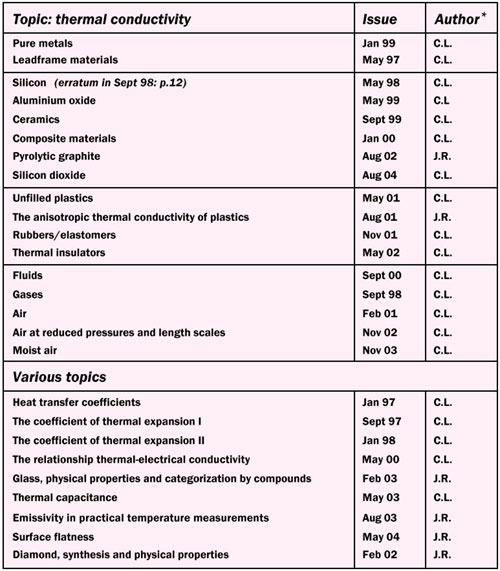 |
*C.L. = Clemens J.M. Lasance, Associate Editor, Philips Research Laboratories
J.R. = Jukka Rantala, Associate Editor, Nokia Research Center








Leave a Reply