
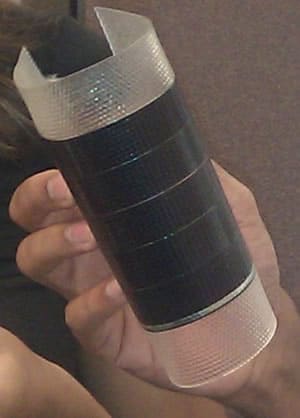
Researchers from the University of California, Berkeley have successfully designed a more efficient solar cell that is capable both of emitting light and absorbing it.
The development came after researchers examined the reasoning behind why such a large gap existed between the theoretical limit to the amount of electrical energy that can be harvested by a solar cell and the actual limit researchers had been able to achieve to date.
A Bay area-based company, co-founded by Eli Yablonovitch, principal researcher and professor at UC Berkeley, developed a solar cell made of gallium arsenide (GaAs) that increased energy-harvesting efficiency from 26 percent to 28.3 percent by allowing photons to escape more easily than in traditional solar cells.
“What we demonstrated is that the better a solar cell is at emitting photons, the higher its voltage and the greater the efficiency it can produce,” Yablonovitch said.
Image: CLEO