
The fourth and future industrial revolutions will set new requirements for smart cities / factories, autonomous vehicles, augmented reality, smartphones, etc., resulting in more distributed architectures, expanding the convergence of new technologies and developments thus, transforming the term Internet of Things (IoT) to Internet of Everything (IoE). Centralized cloud … [Read more...]
Thermal Quality Assessment of Semiconductor Components
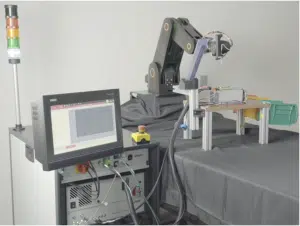
Introduction Reduction in early life failures and continuous quality improvements are “table stakes” for semiconductor manufacturers servicing the automotive industry. “Industry analysts expect that the automotive semiconductor market will be the fastest growing end use market for chips from 2017–21, with a 6.4 percent CAGR and a total market value of between $39-42 billion … [Read more...]
Structure Functions: The Universal Tools for Thermal Design, Testing and Quality Control

Near the end of the 20th century, increasing power levels became the primary challenge in system design, which triggered a complex response from electrical, mechanical and material engineers. The combination of thermal measurements and thermal simulation helped achieve thermally aware system designs. However, no real solution was known for the valid comparison of thermal design … [Read more...]
Calculation Corner: Advective Thermal Resistance
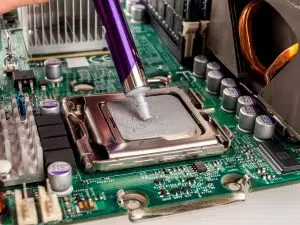
A previous Electronics Cooling article, which discussed the process for analyzing the thermal performance of cooling fans [1], mentioned the need of accounting for the increasing coolant temperature as air passes through a heat sink. That article used an ‘average’ air temperature, which was defined as the midpoint between the inlet and outlet air temperatures. This article … [Read more...]
Better Cooling by Removing Material, Instead of Adding Material, to Unlock the Full Power of GaN Electronics
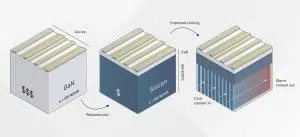
As society is moving from fossil fuels to more sustainable electrical power, the systems for converting and delivering this electrical power are becoming increasingly important. These power electronic systems are responsible for controlling and shaping the electricity between the sources, such as solar and wind, and the end-use destination, such as driving a motor or charging … [Read more...]
- « Previous Page
- 1
- 2
- 3
- 4
- …
- 40
- Next Page »