Rjc (or sometimes ThetaJC, θjc, Rth_jc), the so-called ‘junction to case’ thermal resistance, is a thermal metric that enables comparison of the thermal performance of packaged semiconductor devices from differing suppliers. The JEDEC standard JESD51-14 [1] documents a method for the experimental determination of Rjc. Although applicable for packages that exhibit a … [Read more...]
Tech Brief: Effect of Thermocouple Size
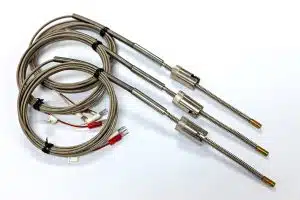
Thermocouples are widely used for temperature measurements. They are particularly useful in lab testing, due to their relatively low cost and the ability to easily fabricate thermocouples of specific lengths for a given test. This Tech Brief discusses issues related to the size of a thermocouple that may be considered when using them. A thermocouple consists of two wires made … [Read more...]
Summary of the IEEE ITherm 2023 Conference

The IEEE Intersociety Conference on Thermal and Thermomechanical Phenomena in Electronic Systems (ITherm) was held at the JW Marriott Grande Lakes, Orlando, FL, May 30 – June 2, 2023. This was the 22nd ITherm, which was first held in 1988. The conference was historically held every other year until 2016 when it switched to an annual schedule. ITherm 2023 was sponsored by the … [Read more...]
Calculation Corner: Properties of Humid Air

INTRODUCTION Long time readers may recall that one answer to the question of how humidity changes the thermal conductivity of air is “Nothing to worry about” [1]. Generally, the effect of humidity on air properties is small enough that it can be neglected. However, at high ambient temperatures and low pressure, humidity effects may need to be addressed in applications such as … [Read more...]
Calculation Corner: A Simple Method for Estimating Radiation Heat Transfer

This article describes a semi-empirical equation that can be used to assess radiation heat transfer in terms of an effective convection coefficient. The effective convection coefficient due to radiation is shown to be: Where temperatures are in °C and ε is the emissivity of the radiating surface. This equation is accurate to within ~10% over a temperature range of 0 - … [Read more...]
- 1
- 2
- 3
- …
- 42
- Next Page »