
Energy isn’t the only thing that is wasted when dealing with hot water supply. Time is as well. The house I live in is nearly 200 years old. It wasn’t a very well made house when it was new and, unlike a good wine, has not got better with time. The retrofitted, refitted, repaired, repaired and repaired again hot water supply system would have benefited from some upfront design. As it is the flow rate of the hot water to the taps (faucets) is as tardy as it is tepid. #FirstWorldProblem, sure, 750 million don’t have access to a clean source of water, let alone a clean source of preheated water. Regardless of the application, getting water from A to B has been a human endeavor for millennia. Fluids simulation helps you do it better.
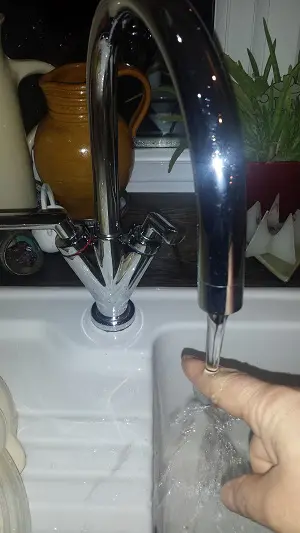 Turn the hot tap on in my kitchen and you have to wait ages for the dribbly stream of water to become hot. Despite knowing this and being reminded of it every day, I still deploy the FFS (fat finger sensor) every time I turn the hot tap on. That’s about 80 seconds of time wasted, just standing there, staring at my finger, waiting. A daily ritual that often involves my beloved hollering “You might as well put the bins out instead of just standing there!”.
The flow is so low because it’s a gravity-fed (and ill-designed) system. A header tank above feeds water to the hot water tank below. There is a then a long run of 15mm diameter plastic pipe to the kitchen sink. The header tank is quite shallow and only a meter or so above the hot water tank. Not much head to force the water out through the ~23m run.
Mentor Graphics acquired Flowmaster 3 years ago, adding it’s ‘1D CFD’ systems simulation capability to the suite of simulation tools offered by the Mechanical Analysis Division. For large fluid dynamics systems, dominated by pipe delivery, 3D CFD is often too computationally inefficient to be deployed. 1D CFD offers a network-based approach to solving for fluid flow and heat transfer in a fraction of the time, allowing pump/pipe sizing to be determined early in the design process.
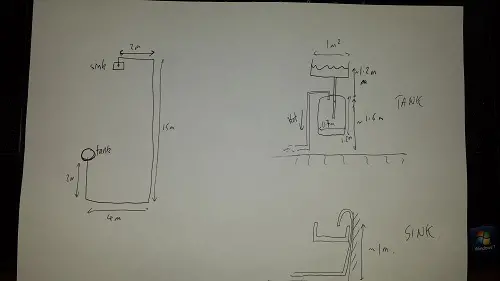 Personally, I’m just beginning to get familiar with the use of Flowmaster, so for this study, I cajoled my colleague Doug Kolak into simulating my hot water system (thanks Doug!). In the absence of a CAD description, I sketched out my configuration for him. And yes, after years of constant keyboard use my drawing skills have regressed to that of an 8-year-old
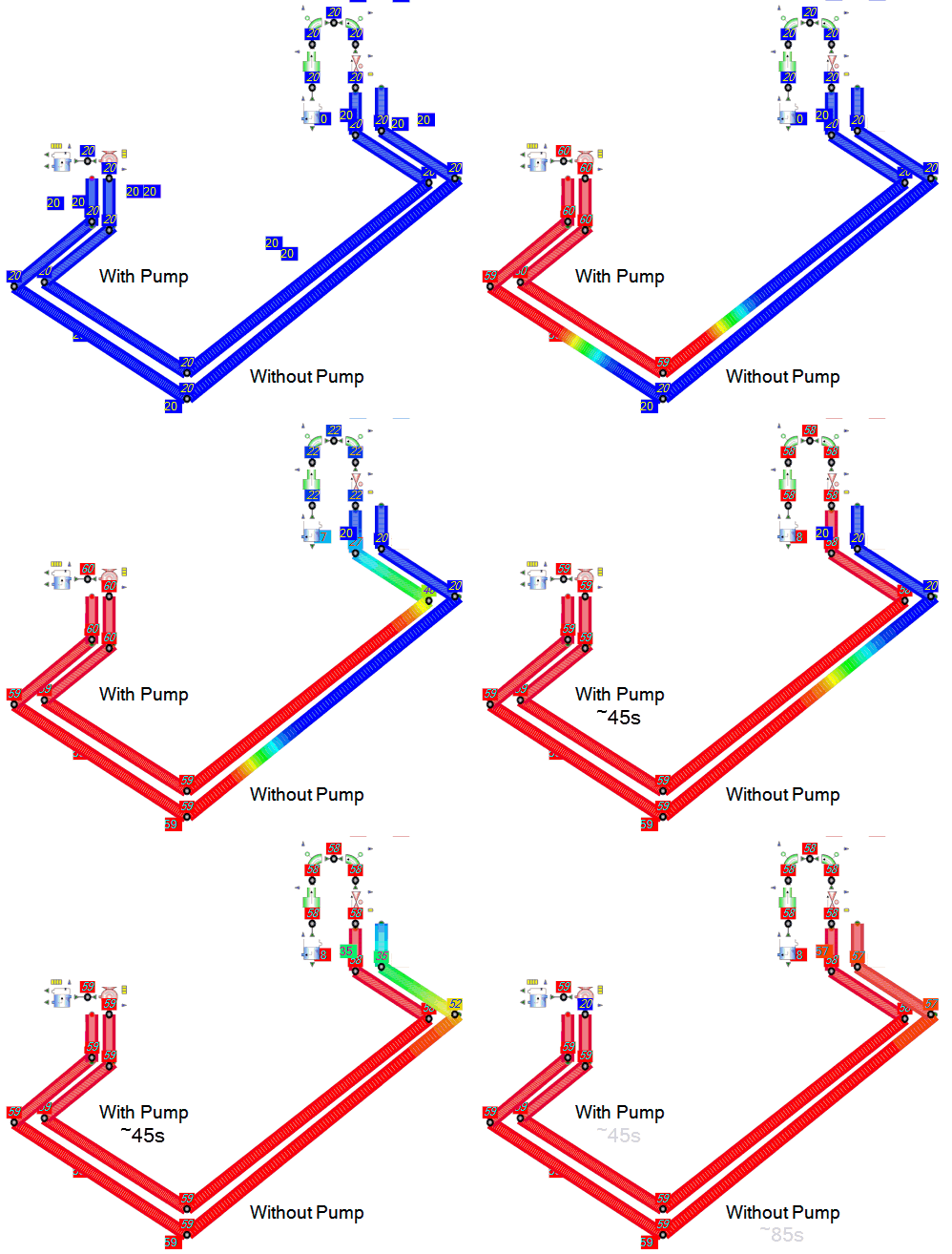
A flow actuated pump would be a beneficial addition to the system. Forcing the water through faster than gravity alone manages. Flowmaster can easily be applied to simulate both configurations, giving an indication of what advantage the pump offers in terms of how long to wait until the water supply heats up and the subsequent sink bowl filling time. The animation shows both configurations, overlayed. Interesting to see how the ‘front’ of hot water becomes diffused leading to a gradual increase of temperature at the tap.
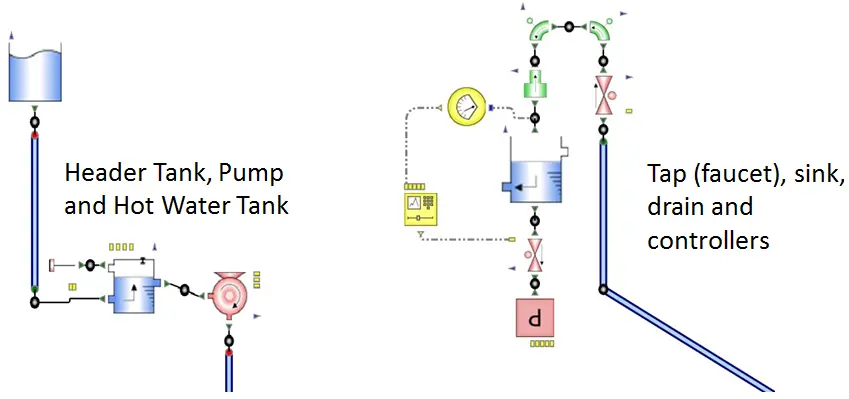 The Flowmaster network is constructed from a number of different components, pre-characterised for their fluid and thermal behaviors. Tanks, pumps, pipes, diffusers, jet pumps, bends, T-junctions, Y-junctions… with over 400 to select from a wide range of applications are covered. Despite the relative simplicity of this model, the control system at the sink end is quite interesting, set to start filling the sink bowl once the temperature of liquid coming out of the tap rises over 40degC (equating to me moving the tap over a plastic bowl in the sink when FFS starts to get too hot), then the tap is turned off when the bowl is filled to 99% of its volume.
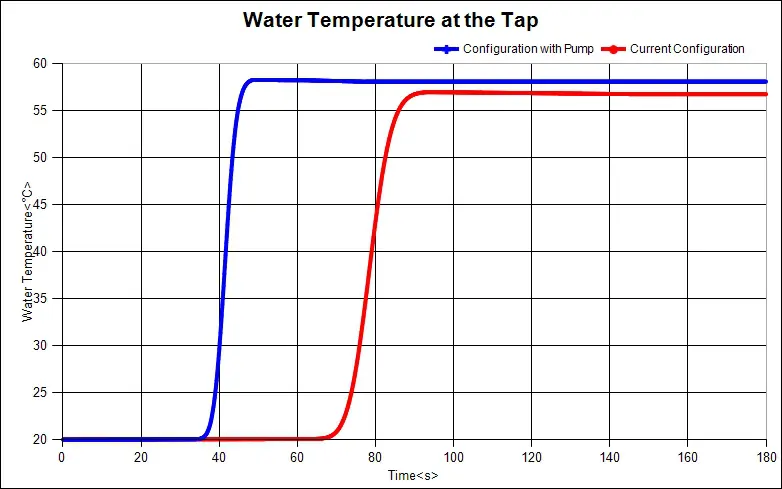
Inclusion of the pump shortens the time it takes for the water at the tap to get warm by about a half, the bowl takes half the time to fill and there is a slight increase in the temperature coming out of the tap (due to there being less time for the water to lose heat as it flows through the pipes, from the tank to the sink).
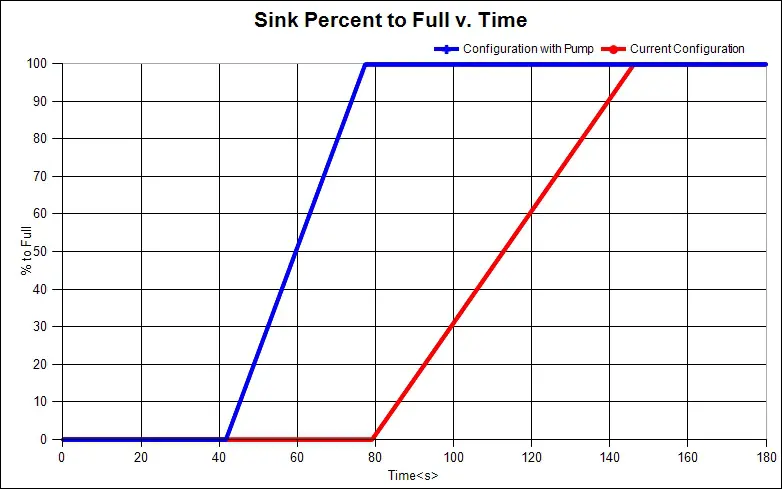 Any further improvement might be had by increasing the diameter of the pipe so that the pump would work at a higher flow rate. In fact, the design challenge could be inverted so that the required time to fill the sink might be defined as an input to the model, the sizing of the components of the hot water system then be determined through simulation so as to achieve that design goal. With simulation time measured in seconds, the way in which Flowmaster can be deployed offers many advantages over classical 3D CFD.
Flowmaster is available for evaluation using our ‘Virtual Lab’ technology. No need to install locally, just log in and get going!
21st January 2015, Ross-on-Wye