
 The shape of the small piece of geometry that is added so as to successively ‘relieve’ the design determines the overall ‘jaggedness’ of the final geometry. A square section rod can only lead to a stair-stepped representation of angled portions of the shape, at worse resulting in a 41% increase (2/root2) in surface area in those regions. Increase in surface area, thus heat transfer might be offset by the increase in surface friction thus reduction in through flow. But why risk relying on a canceling of effects? It’s obvious that those jaggedy edges really want to be smooth. So why not (manually) smooth them?
The geometry was exported out of FloTHERM as STEP, via FloMCAD Bridge, and imported into FloTHERM XT. Think of FloTHERM XT as FloTHERM’s younger sister, an MCAD centric implementation with more arbitrary geometry support. I used the Chamfer command in FloTHERM XT to smooth out those stair steps then went on to simulate the reduction in thermal resistance.
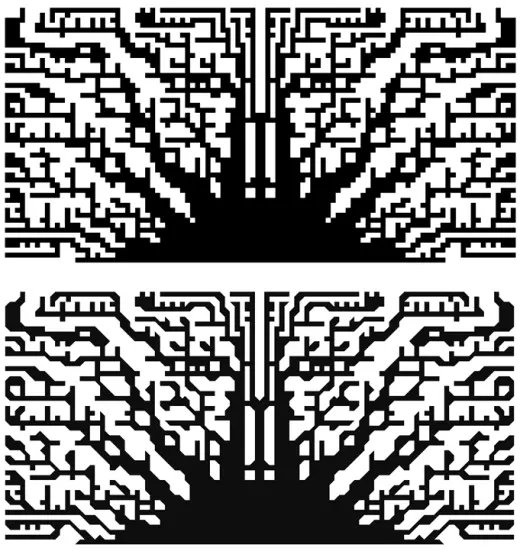
Even though we’re looking at 2D front projections, don’t forget this is full 3D:
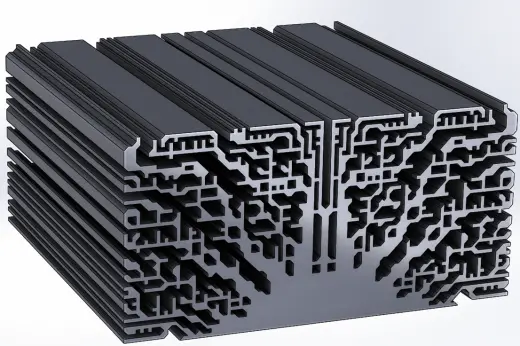
The reduction in Rth was only 1.8% for the canceling out of effects reasons mentioned above (though sure, in a fixed dP environment, not a fixed mass flow, the chamfered Rth reduction would have been greater).
I’m not sure that any other geometric section shape of the additive geometry would have removed this jaggedness effect. A hexagonal shape would be slightly better at resolving 45degree angled sections but not so good at axis-aligned portions. As any player of Lego or user of FloTHERM knows, squares are good. Squares tessellate, are simple to handle and as has been shown here, together are capable of representing the most organic of geometries.
The Constructal Law, whose hand is very much at play in the above heatsink, is best described by its father, Professor Adrian Bejan. The concept goes beyond shapes and technology, into the very essence of the design by evolution and the preservation of living systems, including us humans:
-4-
“With science, we predict and construct our future”
1st April 2015, Ross-on-Wye