Building a competitive electric race car takes more than classroom theory. The Taiwan Tech Formula Student Racing Team applies academic concepts directly to real-world vehicle development. Founded in 2021, the group prepares future talent for the electric vehicle industry by engineering advanced racecars, a process that requires solving complex thermal management challenges to maintain peak performance.
The team has grown from four founding members to approximately 35 students across engineering, industrial management, and design. Mechanical and electrical teams develop individual subsystems before integrating them into the complete vehicle, giving students responsibility for design, manufacturing, project management, and track validation. The racing team primarily competes in the FST Taiwan Formula Student competition and Formula SAE Australasia. In 2023, they entered their first international event, successfully passing all static technical inspections and earning a Special Contribution Award. Domestically, the group finished second overall at the fourth FST competition before securing first place at the sixth, marking their best result in history.
Engineering The Leopard 02 evo
That historic victory came behind the wheel of the Leopard 02 evo, which replaced the original steel tube-frame chassis with a lightweight aluminum-alloy monocoque. The powertrain also evolved from a single-motor, chain-driven rear-wheel-drive configuration to four independently controlled motors.
To support the vehicle’s higher performance targets, the students engineered several custom solutions. Most significantly, the team designed and developed their own traction inverters. They paired these inverters with a decoupled suspension setup and an in-house four-wheel torque control system, while a redesigned carbon-fiber aerodynamic package enhanced the exterior. However, this advanced architecture generated a massive thermal load, requiring a full-vehicle liquid cooling network to manage the extreme heat.
The design overhaul yielded major gains in safety and powertrain stability. The students made extensive use of composite materials to shed excess weight without sacrificing chassis rigidity. To bridge the gap between digital testing and track reality, the team developed physical models that improved the correlation between lap-time simulations and real-world vehicle dynamics.
Overcoming Thermal Management Challenges
High-performance electric race cars face intense thermal management hurdles. For the Leopard 02 evo, the primary challenges centered on the high-voltage motor controllers, motors, and traction battery. These high-power components generate massive amounts of heat under heavy loads. At the same time, the vehicle architecture offers limited space and airflow, and imposes strict weight limits on cooling hardware.
When parts overheat beyond optimal operating ranges, the vehicle suffers from immediate performance degradation. The system might trigger power derating or initiate protective shutdowns to prevent permanent damage. These thermal issues directly hurt lap times, compromise vehicle stability, and threaten the team’s ability to complete endurance events.
To keep the car light and reliable, the engineering team had to minimize thermal resistance between heat-generating components and the surrounding cooling structures. The students evaluated how well different materials compressed and conformed to tight spaces while accounting for material thickness, temperature resistance, and strict electrical insulation requirements. To navigate these complex specifications, the team sought specialized expertise to identify the exact thermal interface materials needed for the vehicle.
Selecting the Right Thermal Interface Materials
The team collaborated with T-Global Technology to improve thermal performance within the constraints of the existing vehicle design. Through a student support initiative, the team evaluated materials based on actual operating conditions rather than relying solely on theoretical specifications.
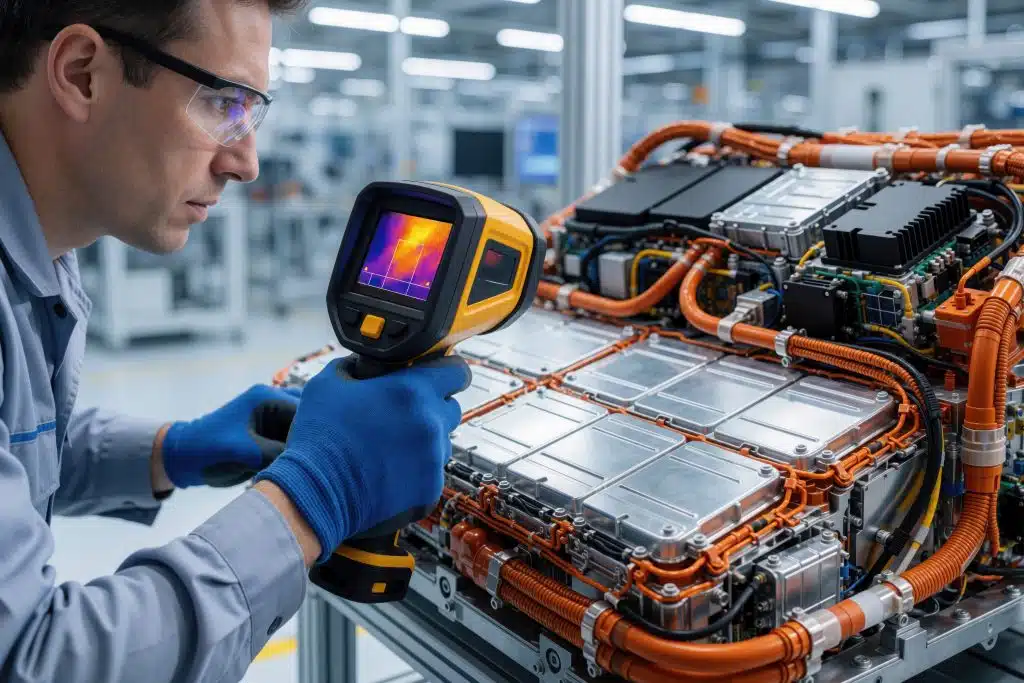
T-Global supplied materials for two critical areas. First, the students applied a soft, electrically insulating thermal pad to the traction battery cells. The material transfers heat while maintaining strict electrical insulation. First, the students applied an electrically insulating thermal pad to the traction battery cells. The material efficiently transfers heat while its natural compressibility accommodates battery-cell expansion and mechanical assembly tolerances. Second, the team utilized thermal grease in the power modules of the high-voltage motor controllers. As a thermal interface material, the grease reduces the thermal resistance at the interface between the power modules and the cooling structures.
T-Global also supported the students with application evaluation and technical discussions. The engineering group evaluated potential solutions based on structural constraints, operating conditions, and electrical safety. The collaboration helped the students select materials suited to the vehicle’s actual architecture while reducing unnecessary trial and error.
Testing, Validation, and Race-Day Performance
Validating the thermal materials involved a rigorous process. The team first used simulation software to confirm that the thermal properties and overall heat-transfer paths met the initial design targets. Following the simulations, the students implemented the selected solutions for full-vehicle testing. During track sessions, the team continuously monitored key component temperatures and overall system conditions.
The 30-minute, 22-kilometer endurance event puts the traction battery, motors, and motor controllers under sustained high-load operation. By integrating the right thermal materials, the team successfully mitigated the risk of overheating and protective shutdowns. As a result, the vehicle maintained stable temperatures and delivered consistent, peak power output throughout the entire endurance race.
Bridging Academia and Industry
Working with industrial-grade materials changed the students’ understanding of thermal management. Classroom theory focuses on individual variables under controlled conditions, whereas a race car operates under high loads, heavy vibration, strict space constraints, and demanding safety protocols.
The team learned that effective thermal management goes beyond selecting a material with the highest thermal conductivity. Engineers must carefully consider interface contact, material thickness, compressibility, and long-term reliability. The students integrated material selection, mechanical design, and full-vehicle validation into a complete engineering development process. These methods apply directly to commercial electric vehicles and power electronics, preparing the students for professional engineering careers.
Looking Ahead to Future Competitions
Following the 2026 FST championship, the Taiwan Tech Formula Student Racing Team continues preparing for Formula SAE Australasia. Future technical development may include a carbon-fiber monocoque chassis, 10-inch tires, and autonomous driving systems. In the longer term, the team hopes to compete in European Formula Student events while establishing a mature system for transferring technical knowledge to act as a stronger bridge between academia and industry.
The Leopard 02 evo project successfully demonstrated the importance of practical thermal-material selection in high-performance environments. As the team looks ahead, future vehicle architectures will inevitably present new and more demanding thermal challenges. The collaboration with T-Global provides a strong foundation for further material evaluation, passing valuable engineering experience on to the next generation of student innovators.