
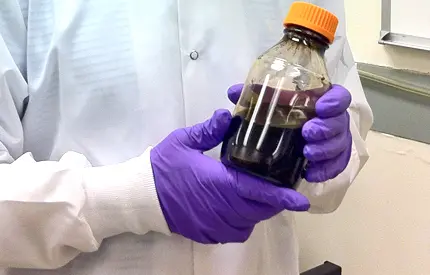
 In a study published today in Physical Review B, Yale electrical engineering professor Hur Koser and colleagues from the University of Georgia and Massachusetts Institute of Technology demonstrate for the first time an approach that allows ferrofluids to be pumped by magnetic fields alone.
Their approach could lead to highly compact, integrated, quiet, and efficient liquid cooling schemes for portable, high-performance consumer electronics. For instance, ferrofluid cooling would eliminate the need for fans and heat plumbing inside computers, enabling further miniaturization.
Developed in the 1960s by NASA scientists seeking a non-mechanical method for moving liquid fuels in outer space, ferrofluids are made up of magnetic nanoparticles suspended in liquids such as oil, water, or alcohol.
The ferrohydrodynamic pump method works when electrodes wound around a pipe force magnetic nanoparticles within the ferrofluids to rotate at varying speeds. Those particles closest to the electrodes spin faster, and it is this spatial variation in rotation speed that propels the ferrofluid forward.