
Abstract
With increasingly strict regulations on lithium-ion battery (LIB) thermal runaway (TR) and safety, rapid detection has become essential to ensure passengers can evacuate safely in electric vehicles (EVs). Early TR detection requires temperature sensors to monitor battery behavior. Incorporating many sensors increases both cost and system complexity, so commercial batteries often rely on a limited number of them, which can delay TR detection. This article presents a novel battery module layout that enables rapid TR detection with fewer sensors by integrating an intermediate aluminum sheet, which also improves temperature uniformity during normal operation.
Introduction
Current battery safety standards, such as IEC 62660-3, evaluate cell behavior under mechanical, electrical, and environmental abuse conditions, including vibration, shock, crushing, short circuits, overcharge, and thermal cycling [1]. However, thermal runaway (TR) events in lithium-ion battery (LIB) systems continue to occur in real applications, indicating that compliance with existing standards does not eliminate all risks. Recent incidents in electric vehicles (EVs) illustrate this fact, in some cases leading to severe consequences [2,3].
Although commercially available LIB cells are generally manufactured under very stringent quality controls, a small fraction inevitably fails due to manufacturing defects, such as internal particle contamination, separator damage, or misalignment of electrodes, which in the worst case could lead to a TR event [4]. Estimates suggest that approximately one to ten cells per million may fail [5], even when the battery management and thermal management systems (BMS and BTMS) operate correctly. While the probability of a defective cell may be negligible in small devices, it becomes significant in EVs, which contain on the order of hundreds to thousands of cells within a single battery pack. As the total cell count increases, so does the probability that at least one cell will exhibit abnormal behavior during its lifetime. Consequently, both research and regulatory efforts are increasingly focused on the early detection of TR and on strategies to prevent its propagation. Table 1 summarizes the current regulatory standards on TR events and safety under development in China, Europe, and the United States. Overall, fast TR detection capabilities are vital to comply with those regulations and ensure passengers’ safety.
| China | Europe | United States | |
|---|---|---|---|
| Regulation | GB 38031- 2025 update |
UNECE -R-100 |
FMVSS305a |
| Insights |
|
|
|
Table 1: Ongoing Thermal Runaway regulations in China, Europe and the United States (adapted from [6]).
Stricter TR detection standards increase the need for accurate temperature monitoring. Physical sensors remain the most reliable option, and industry typically uses one sensor for every ten cells placed at hot or cold spots [7]. However, sensors placed too far from the failing cell may miss early TR signs, making it difficult to comply with safety standards. The detection time of TR is influenced not only by the proximity of the sensor to the failing cell but also by factors such as cell chemistry, state of charge (SoC), and the energy released during the event.
An Alternative Battery Module Concept for Electric Vehicles
A novel battery module layout was originally introduced by the authors in [8] with the goal of improving thermal uniformity among lithium-ion cells. It consists of the incorporation of an aluminum sheet at mid cell-height. Aluminum is a lightweight, widely available material with excellent thermal conductivity. Ensuring a uniform temperature distribution within a battery pack is essential for achieving long service life and stable performance. When some cells operate at higher temperatures than others, they tend to age faster, leading to uneven degradation that ultimately reduces the capacity and reliability of the entire system. For this reason, it is generally recommended that temperature gradients within a pack remain below 5°C, even though differences above 10°C may still occur under common operating conditions [9].
This battery module layout idea was later expanded in [10], where it was shown that the same aluminum sheet can also serve as an effective platform for temperature sensor placement, enabling rapid detection of potential TR events. Figure 1 presents the concept, where the module is built using cylindrical 26650 cells.
The dimensions of the aluminum sheet must be carefully selected to balance thermal performance, added weight, and cost. For the module analyzed, a sheet thickness of approximately 10 mm was considered sufficient to maintain temperature gradients below the recommended limit under normal operating conditions.
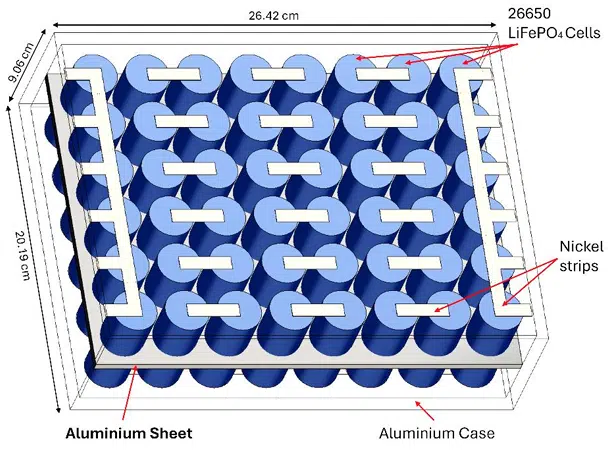
The effectiveness of TR detection with the novel module layout was evaluated by the authors in [10]. Finite Element Method (FEM) simulations were conducted in Comsol Multiphysics. A reference Heat Release Rate (HRR) curve versus time was used for the failing cell to conduct the FEM simulations, while balanced heat generation of 1 W (representing Joule losses and entropy-related contributions) under normal operating conditions, was assumed for the healthy cells. Placing only 5 NTC sensors for the 48 cells (consistent with automotive cell-to-sensor ratios) was demonstrated to be sufficient for temperature estimation and fast TR detection, regardless of which cell fails.
Enjoying this article?
Subscribe to Electronics Cooling for practical, engineer-focused insight on today’s thermal management challenges—plus immediate access to new digital magazine issues.
Subscribe here →
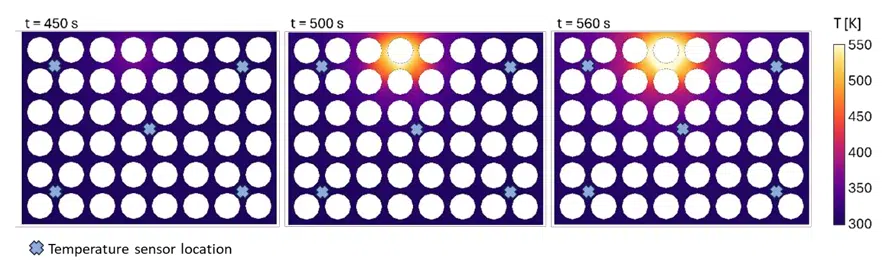
To illustrate TR heat spread within the aluminum sheet, Figure 2 shows the time evolution of the heat through the aluminum sheet when one of the cells of the battery module fails. Different failing cells have been simulated to detect the worst-case scenario. A two-level detection strategy was adopted, relying on both measured temperature and its rate of change. With alarm thresholds of 50°C for temperature and 0.1°C/s for the gradient, the system could trigger an alert on the order of tens of seconds after the cell venting when only the gradient is considered. This provides a fast, safety-oriented early warning. When both criteria are met simultaneously (exceeding temperature value and gradient thresholds), detection occurs slightly later (in just over one minute), providing a confirmation alarm if both conditions are satisfied.
Weight and Cost Considerations
The incorporation of an aluminum sheet in battery modules adds extra weight. For example, with a reference module constituted by 48 cells, this additional weight is estimated at 0.67 kg, while the energy per module is 8.58 Wh × 48 = 411 Wh. For a typical EV, some reference characteristics are summarized in Table 2.
| Characteristic | Value |
|---|---|
| Total vehicle energy (kWh) | 30 – >100 |
| Average consumption (kWh/km) | 0.13 – 0.24 |
| Battery pack weight (kg) | 250 – >900 |
Table 2: Reference values for a typical medium-sized electric vehicle.
Using the Nissan Leaf with a 62 kWh battery pack as an example, approximately 150 modules of 0.411 kWh each would be required. The vehicle has an average consumption of 0.16 kWh/km, which results in a range of 385 km.
The vehicle’s minimum weight is of 1760 kg and the battery pack typically accounts for 20–30% of the total vehicle weight, which is also consistent with values in Table 2. The additional weight from the aluminum sheet would be of 0.67 kg × 150 ≈ 100 kg. In [11], authors estimate that 100 kg of vehicle mass increases energy consumption by 0.2 ±0.1 kWh/100 km. The new range can be estimated as:

This analysis suggests that adding the aluminum sheet does not significantly compromise vehicle range, supporting the feasibility of the proposed solution.
From an economic standpoint, based on current market prices, the estimated cost of the aluminum sheet per module (excluding machining) is approximately €47. Considering a unit price of €2 for high-performance battery-application-oriented Eaton NRG epoxy- sealed radial-lead NTC thermistors, adding five sensors would incur an additional cost of €10. In contrast, placing a single NTC at each cell surface in a conventional configuration, in order to guarantee fast TR detection, would cost around €96. Both approaches remain within the same order of magnitude in cost, but the use of lower-cost NTC thermistor alternatives could further reduce expenses. Overall, this analysis demonstrates that the proposed modifications are not only technically viable but also economically reasonable.
Conclusions
In conclusion, the proposed battery module solution enables fast detection of TR with a reduced sensor-to-cell ratio (below one to ten), thanks to the strategic placement of temperature sensors within the intermediate aluminum sheet. In addition, the good thermal conductivity of aluminum promotes a more uniform temperature distribution across the cells. This is expected to ultimately extend the battery lifespan by achieving a more homogeneous degradation. Both features are highly attractive for demanding applications such as electric vehicles. Besides, the solution appears technically and economically feasible, with low impact on driving range. Moreover, for stationary applications, where weight is not a critical concern, the proposed solution could be adopted as well.
Additional studies are needed to confirm these benefits and to identify potential improvements. Future work should include broader experimental characterization under TR conditions, re-evaluation of detection speeds for different chemistries and cell formats, analysis of the aluminum (or other alternative materials) sheet’s impact on fire propagation, and exploration of sensor placement options to further reduce the number of temperature sensors.
References
[1] Jin, C., Sun, Y., Wang, H., Lai, X., Wang, S., Chen, S., Rui, X., Zheng, Y., Feng, X., Wang, H., & Ouyang, M. (2021). Model and experiments to investigate thermal runaway characterization of lithium-ion batteries induced by external heating method. Journal of Power Sources, 504, 230065. https://doi.org/10.1016/j.jpowsour.2021.230065.
[2] Cao, Y., Peng, Y., Tao, Z., Yang, R., Li, W., Wolski, L., Capek, T., & Zhang, H. (2025). Comprehensive investigation of early gas detection in lithium iron phosphate pouch batteries under overheating. Journal of Power Sources, 653, 237601. https://doi. org/10.1016/j.jpowsour.2025.237601.
[3] Chen, Y., Kang, Y., Zhao, Y., Wang, L., Liu, J., Li, Y., Liang, Z., He, X., Li, X., Tavajohi, N., & Li, B. (2021). A review of lithium-ion battery safety concerns: The issues, strategies, and testing standards. Journal of Energy Chemistry, 59, 83–99. https://doi. org/10.1016/j.jechem.2020.10.017.
[4] Hu, X., Gao, F., Xiao, Y., Wang, D., Gao, Z., Huang, Z., Ren, S., Jiang, N., & Wu, S. (2024). Advancements in the safety of lithium-ion battery: The trigger, consequence and mitigation method of thermal runaway. Chemical Engineering Journal, 481, 1–19. https://doi.org/10.1016/j.cej.2023.148450.
[5] DNV GL Maritime Advisory. (2016). DNV GL handbook for maritime and offshore battery systems (Technical Report). DNV GL.
[6] Edmondson, J. (2025, April 24). New standards put China in the lead for the safest & largest EV market. IDTechEx. https://www. idtechex.com/en/research-article/new- standards-put-china-in-the-lead-for-the-safest-and-largest-ev-market/33109.
[7] Deshpande, V. M., Bhattacharya, R., & Subbarao, K. (2022). Sensor placement with optimal precision for temperature estimation of battery systems. IEEE Control Systems Letters, 6, 1082–1087. 10.1109/LCSYS.2021.3089564.
[8] Gerbino, F., Spaggiari, D., Sainz de la Maza, A., Ibarra, E., Anseán, D., & Santoro, D. (2025). Impact of sensor positioning on temperature measurement accuracy in battery modules. In 2025 IEEE International Workshop on Metrology for Automotive (MetroAutomotive) (pp. 1–6). IEEE. https://doi.org/10.1109/MetroAutomotive64646.2025.11119199.
[9] Lin, X., Perez, H. E., Siegel, J. B., & Stefanopoulou, A. G. (2020). Robust estimation of battery system temperature distribution under sparse sensing and uncertainty. IEEE Transactions on Control Systems Technology, 28(3), pp. 753–765. 10.1109/ TCST.2019.2892019
[10] Sainz de la Maza, A., Gerbino, F., Spaggiari, D., Santoro, D., Ibarra, E., Anseán, D., Trancho, E., & Delmonte, N. (2025). Temperature estimation and thermal runaway detection in a novel battery module arrangement incorporating a reduced number of sensors. In 2025 31st International Workshop on Thermal Investigations of ICs and Systems (THERMINIC) (pp. 1–6). IEEE. https://doi. org/10.1109/THERMINIC65879.2025.11216943.
[11] Weiss, M., Winbush, T., Newman, A., & Helmers, E. (2024). Energy Consumption of Electric Vehicles in Europe. Sustainability, 16 (17), 7529. https://doi.org/10.3390/su16177529.