EDITOR’S NOTE: This article is based on a presentation delivered at Thermal Live Fall 2025 by Mark MacDonald, Thermal Technologist at Ventiva, where he outlined how electrohydrodynamic (EHD) air movers — branded as the Ionic Cooling Engine (ICE) — are redefining thermal system architecture.
For decades, electronics cooling has relied on mechanical blowers. Bearings spin, blades accelerate air, and designers work around circular fan footprints that dictate motherboard layouts, enclosure dimensions, and acoustic performance.
The Ionic Cooling Engine from Ventiva introduces a fundamentally different mechanism: electrohydrodynamic airflow. Rather than spinning blades, ICE devices use high-voltage electric fields to ionize air molecules and accelerate them toward a collector electrode. As those ions move, they collide with neutral air molecules, generating bulk airflow.
The result is a thin, solid-state air mover with no moving parts.
Each ICE module is approximately four millimeters tall and operates at high voltage (around five kilovolts) but extremely low current. Total system power draw for a standard 62 mm active-length module is typically under one watt. The airflow velocity approaches that of thin notebook blowers, typically in the range of three to five meters per second, though the pressure head is lower, typically 10 to 20 pascals.
The payoff is silence. In testing, these devices can be difficult to detect even in controlled acoustic environments, enabling true fanless airflow without sacrificing forced convection.
The Notebook Constraint Problem
Notebook thermal design is increasingly constrained by acoustics, form factor, and signal routing.
As users demand quieter systems, fan diameters increase so they can spin more slowly. Larger fans, however, require large circular cutouts in the motherboard. These cutouts create routing bottlenecks for high-speed signals traveling from the system-on-chip to I/O connectors. Designers compensate with higher layer-count boards, which increases cost and manufacturing complexity.
Mechanical blowers also require right-angle airflow: air enters vertically, turns 90 degrees into the impeller, and exits horizontally. That geometry works against thin, planar notebook architectures.
ICE modules operate with side-in, side-out flow aligned with the board plane. Their elongated rectangular footprint allows designers to relocate thermal modules to the rear edge of the system, reclaiming motherboard area previously consumed by fan apertures.
MacDonald emphasized that this reclaimed space is not trivial. As AI workloads drive growth in memory, storage, and edge compute density, internal volume becomes strategic real estate. A thinner, quieter system that also enables more flexible board design represents both a performance and cost advantage.
Designing in Parallel, Not in Series
A key insight from the session was that ICE devices should not be treated as drop-in blower replacements. Their lower pressure head requires a different coupling strategy.
Traditional cooling paths place system impedance and heat exchanger impedance in series: air moves across the motherboard, through the blower, then across the heat exchanger. Each stage adds pressure drop.
With modular ICE devices, airflow paths can be separated and run in parallel. For example, one ICE module can cool the motherboard surfaces, while separate modules drive air directly through heat exchangers. Each air mover handles only a portion of total flow, and no single stream encounters the full impedance stack.
This parallel architecture reduces overall flow resistance and improves effective heat transfer, even with lower static pressure capability.
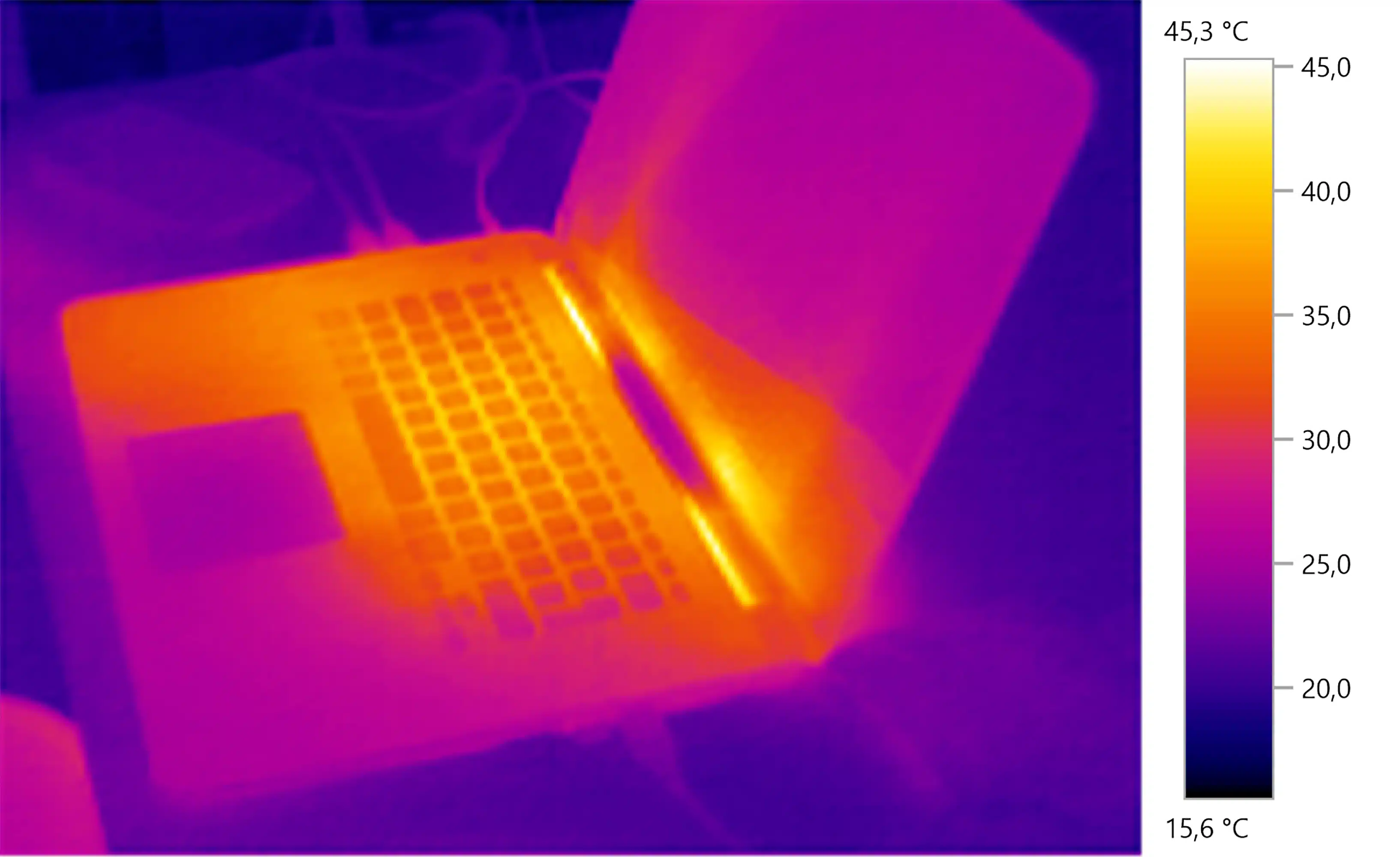
MacDonald presented modeling results for a 28 W CPU notebook in a sub-16 mm chassis using three ICE modules. The system achieved comfortable skin temperatures, typically in the 30–40°C range, under a 25°C ambient. A higher-power configuration using five modules was shown as scalable toward 45 W CPU and 100 W system-class designs.
Reliability, Ozone, and Environmental Concerns
Historically, ionic wind devices have faced skepticism regarding ozone generation, dust accumulation, and humidity sensitivity.
Ventiva addresses ozone formation through manganese dioxide catalytic coatings, an established industrial method for converting ozone back into oxygen. Sub-100 ppb exhaust concentrations are achievable and compliant with regulatory limits.
Dust mitigation relies on active control within the power delivery system. The ICE power supply monitors operating conditions in real time and can respond dynamically to contamination. MacDonald noted that the system undergoes standardized dust qualification comparable to blower testing.
Enjoying this article?
Subscribe to Electronics Cooling for practical, engineer-focused insight on today’s thermal management challenges—plus immediate access to new digital magazine issues.
Subscribe here →
Humidity does influence ionization efficiency at extreme levels, particularly at elevated temperatures combined with high moisture content. However, the system is designed to tolerate environmental conditions exceeding typical consumer use cases. If excessive moisture is present, the device self-protects and resumes normal operation once conditions stabilize.
Ventiva reports that the devices are being qualified against the same reliability standards applied to traditional blower systems. With no bearings, coils, or other mechanical wear elements, ICE modules may avoid several degradation mechanisms associated with ultra-thin mechanical fans.
Beyond Notebooks: A Broader Design Horizon
Although notebooks represent a compelling initial application due to their acoustic sensitivity and tight geometry, the technology extends beyond portable PCs.
High-density servers, memory arrays, edge compute modules, SSD stacks, and even wearable electronics present opportunities where localized, silent airflow is valuable. ICE modules can be scaled in length, stacked vertically, or tailored for spot-cooling scenarios.
Because the airflow generation mechanism is fundamentally two-dimensional, active length can be adjusted to suit targeted applications. Smaller implementations for focused cooling are technically feasible, though performance scales proportionally with length.
The combination of silent operation, modular geometry, and planar airflow alignment opens possibilities in micro-PCs, edge devices, augmented-reality hardware, and compact AI platforms.
A Shift in Thermal Architecture
The broader implication of ICE technology is architectural rather than incremental.
Mechanical fans have shaped electronics layout for decades. Their circular footprints, acoustic characteristics, and airflow directionality constrain industrial design and board routing decisions.
Electrohydrodynamic air movers introduce a new design grammar: thin, silent, modular airflow elements that can be distributed strategically rather than centralized.
For thermal engineers, that means new knobs to tune. For electrical engineers, it means fewer routing bottlenecks. For product designers, it means quieter systems with more usable internal volume.
The transition will require rethinking airflow paths and abandoning assumptions inherited from blower-centric systems. However, the potential advantages in acoustic performance, layout flexibility, and modular scalability suggest that ionic cooling could become a foundational technology for next-generation electronics.
Watch the Full Thermal Live Session
This article summarizes key insights from Mark MacDonald’s presentation at Thermal Live Fall 2025. The full session includes detailed airflow modeling data, reliability discussion, and live Q&A.