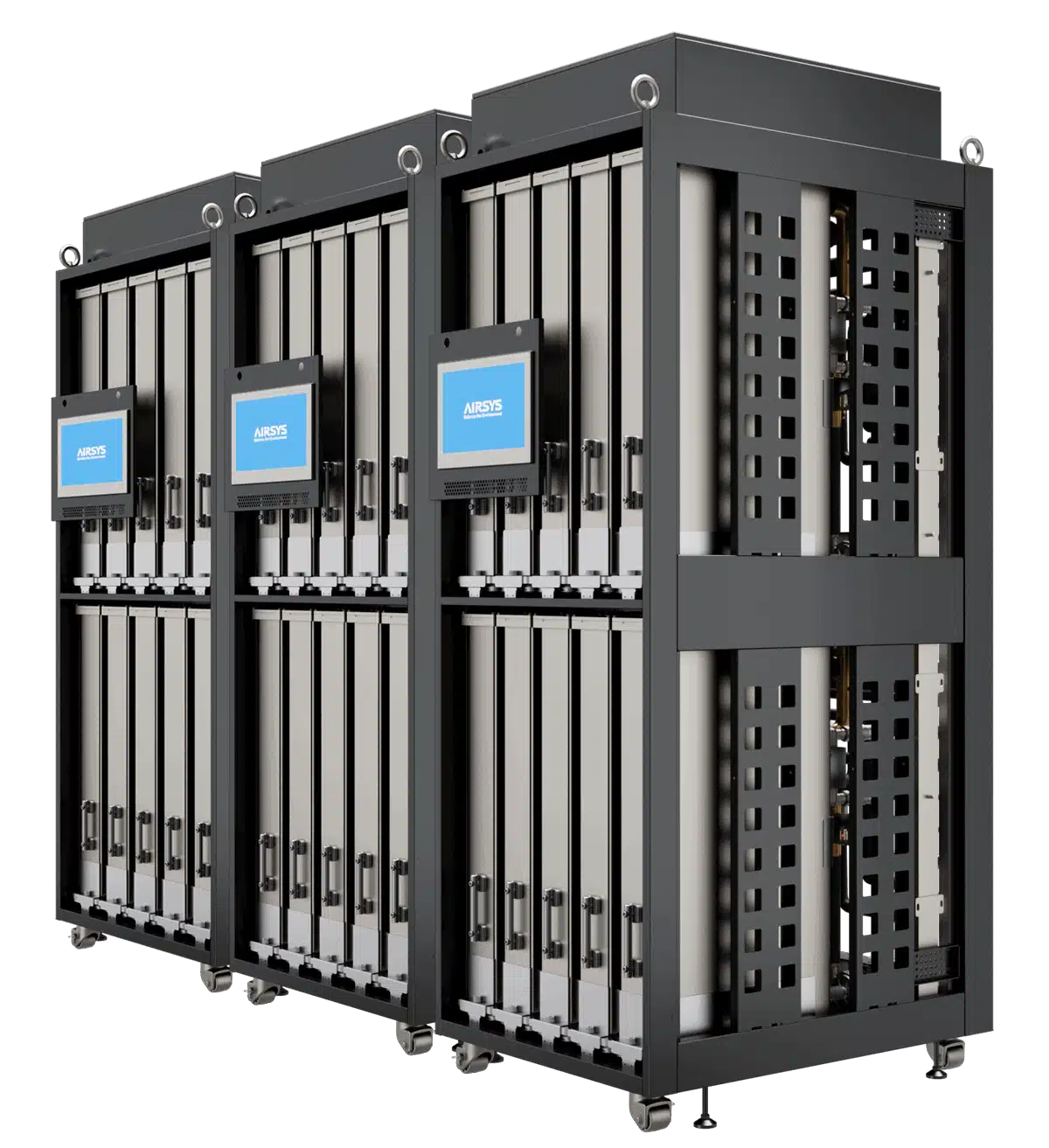
As data-center rack densities climb and AI/HPC workloads expand, cooling infrastructure must evolve. Traditional approaches face growing limitations in capacity, scalability, efficiency and footprint. The Airsys PowerOne platform addresses these challenges through a modular, multi-medium cooling architecture engineered for modern compute environments.
Technical Highlights
-
Scale range: supports IT-loads from ~1 MW to 100 + MW — from edge to hyperscale.
-
Modular build with multiple cooling mediums (air, liquid, hybrid) to adapt to facility type, rack power density, and growth trajectory.
-
Two principal solution tracks:
-
Standard Cooling Stack, which includes:
-
CritiCool‑X™ – magnetic-bearing centrifugal chiller with free-cooling capability (500 kW-1 MW)
-
FluidCool‑X™ – precision Cooling Distribution Unit (CDU) for dense workloads (500 kW-2 MW)
-
MaxAir™ – compact modular fan-wall / CRAC variant optimized for high air-flow retrofit or greenfield applications.
-
Optima2 CW™ – chilled-water CRAH unit aimed at high-density compute zones.
-
-
LiquidRack™ Solution, a single-phase liquid spray cooling architecture for extreme density / AI workloads, offering compressor-less free-cooling mode and closed-loop capability.
-
-
Metrics and performance:
-
Introduction of PCE (Power Compute Effectiveness) alongside PUE — PCE quantifies how much of provisioned power becomes usable compute output, not just facility overhead.
-
Emphasis on reducing water usage (for example, 0 WUE claimed in certain configurations) and optimizing free-cooling and airflow management.
-
Engineering Considerations & Deployment Scenarios
Growth-aligned architecture: The modular nature of PowerOne means you can scale cooling in pace with compute expansion, avoiding over-build of infrastructure that remains idle.
Retrofit and hybrid readiness: Whether upgrading an existing air-cooled facility or deploying liquid/hybrid cooling for new builds, the platform supports mixed cooling mediums.
High-density zone readiness: For racks or pods with several kW per rack (AI/HPC), the LiquidRack spray cooling track is appropriate; for moderately dense zones, CDUs or air-based fan-walls may suffice.
Thermal loop design: Higher entering water temperatures, optimized ΔT, and free-cooling capability are design drivers; for example, the CritiCool-X chiller supports very high ambient temperatures and a closed-loop air-cooled condenser.
Infrastructure metrics: In specification modelling, include both PUE and PCE. Cooling selection should aim not just at lowering overhead but at increasing the proportion of power driving compute.
Operational reliability: Modular sub-components, standardized spares, and the ability to service components rapidly can impact downtime and lifecycle cost.
Recommended Use-Cases
-
New hyperscale builds where future growth is uncertain — the modular PowerOne architecture allows incremental addition of cooling capacity.
-
Data-center modernization programs: replacing legacy CRAC/CRAH arrays in brown-field facilities and preparing for greater rack power densities without a full rebuild.
-
AI/HPC training clusters or GPU-heavy racks where rack-level heat-flux exceeds traditional cooling capability; the LiquidRack track offers an option for spray-liquid cooling.
-
Mixed environments (colocation, enterprise) where a facility may evolve from air-to-liquid or hybrid cooling over time — the same platform supports that transition.
Summary
For engineering teams planning cooling for modern data-centers, the PowerOne platform represents a comprehensive architecture built for scalability, density and efficiency. Its modular design, support for multiple cooling mediums, and focus on compute-effectiveness (PCE) make it a credible alternative to legacy systems. Key questions to investigate with respect to your project should include: What are the projected rack densities? What liquid (or air) cooling mode is most appropriate? What entering water, ΔT and free-cooling metrics are achievable on your site? And how will cooling infrastructure scale in pace with compute growth without becoming stranded?