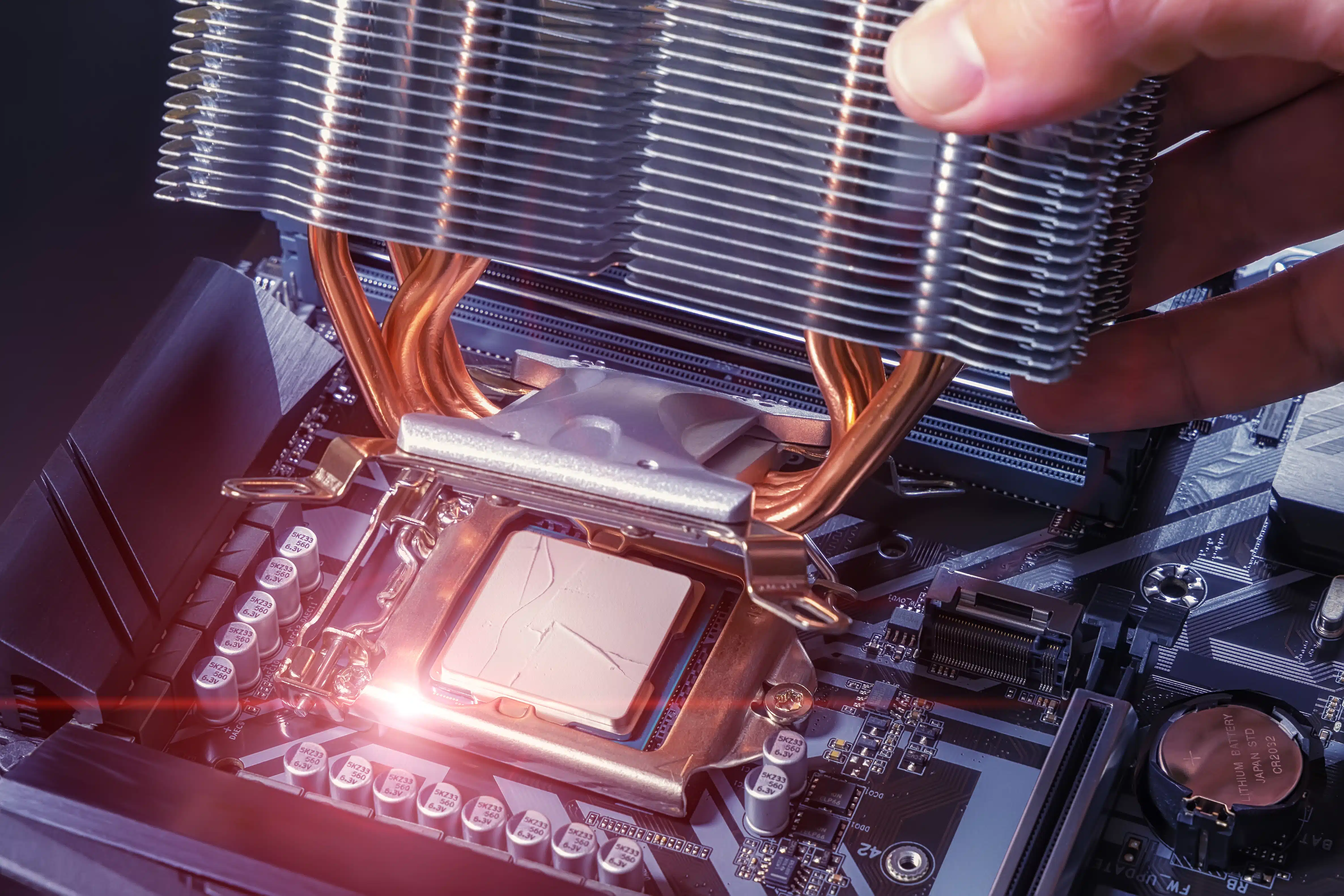
Thermal management has become one of the defining challenges in modern electronics design. Across data centers, AI and machine learning hardware, power electronics, and compact consumer devices, heat generation continues to rise as performance expectations increase. Higher power densities, faster processing speeds, and smaller form factors are placing sustained pressure on traditional cooling approaches.
This shift has created a widening gap between how much heat systems generate and how effectively that heat can be removed. Air cooling alone is often no longer sufficient, especially in high-density or enclosed environments where hotspots can develop quickly. Left unmanaged, excess heat can reduce performance and shorten component lifespan.
To address these challenges, engineers rely on a combination of thermal interface materials (TIMs) and advanced heat spreading technologies. Among the most widely used solutions are vapor chambers and thermal pads, which play complementary roles in modern thermal architectures. Understanding how these technologies differ — and how they work together — is key to building effective thermal management strategies.
Understanding Vapor Chambers
For high-power and high-heat-flux applications, vapor chambers are typically the more suitable solution for heat spreading, while thermal pads play a critical supporting role in improving interface efficiency.
Vapor chambers are advanced heat spreading devices that use phase-change principles to transfer heat efficiently across a surface. Inside the chamber, a working fluid absorbs heat and evaporates, moving toward cooler regions where it condenses and releases that heat. A wick structure then returns the fluid to the heat source, creating a continuous cycle.
Unlike heat pipes, which move heat along a linear path, vapor chambers distribute heat across a planar surface. This makes them particularly well-suited for applications where heat must be spread evenly across high-density components.
Because of their high effective thermal conductivity, vapor chambers are widely used in GPUs, CPUs, data center hardware, telecom systems, and industrial electronics. They help minimize hotspots and maintain uniform temperature profiles, which supports stable system performance and long-term reliability.
Understanding Thermal Pads
Thermal pads are soft, conformable thermal interface materials designed to fill air gaps between components and improve heat transfer across imperfect surfaces.
Compared to thermal paste, thermal pads offer a cleaner and more consistent solution. They maintain a defined thickness, simplify assembly, and allow for easier rework.
Thermal pads are available in a wide range of thermal conductivities and are often selected based on compressibility and gap-filling capability. Many also provide electrical insulation, making them suitable for sensitive electronic assemblies.
They are commonly used between PCBs and heatsinks, in power modules, within enclosures, and across LED systems. In each case, their role is to reduce thermal resistance at the interface and enable efficient heat transfer between surfaces.
Key Differences: Vapor Chambers vs. Thermal Pads
Vapor chambers and thermal pads serve fundamentally different roles within a thermal management system.
A vapor chamber functions as a heat spreader, redistributing thermal energy across a surface to prevent localized hotspots. It operates within the internal heat transport layer of a system. A thermal pad, by contrast, acts as a thermal interface, improving contact between two surfaces and reducing resistance at that junction.
From a performance standpoint, vapor chambers address heat distribution, while thermal pads address interface efficiency. Both are essential, but they operate at different points in the thermal path.
Understanding these distinctions helps engineers select the right materials for each part of the system, rather than relying on a single solution to solve multiple thermal challenges.
Why Modern Systems Require Both Vapor Chambers and Thermal Pads
As electronic systems become more compact and more powerful, thermal management strategies must evolve beyond single-component solutions. A layered approach is now common, where multiple technologies work together to move heat efficiently.
A typical configuration might include a semiconductor device connected to a vapor chamber through a thermal pad, with the vapor chamber transferring heat to a heatsink or cooling system. In this structure, each component contributes to the overall thermal pathway.
The thermal pad ensures efficient contact and minimizes interface resistance, while the vapor chamber spreads heat across a larger area. This combined approach improves heat transfer efficiency, reduces thermal gradients, and helps maintain stable operating conditions.
Engineers are increasingly evaluating thermal solutions as part of an integrated system rather than as isolated components. This shift reflects the growing complexity of modern electronics and the need for coordinated thermal design.
Design Considerations for Engineers
Selecting between vapor chambers and thermal pads — or determining how and when to combine them — requires careful evaluation of system requirements.
Power density and heat flux determine how aggressively heat must be removed. Mechanical constraints, including gap tolerances and compression limits, influence material selection and performance. Thermal pads must be able to conform to surface irregularities without overstressing components.
Reliability is another major factor. Materials must maintain performance over time, even under temperature cycling, vibration, and environmental exposure. Engineers must also consider risks such as material degradation, dry-out in phase-change systems, or loss of interface integrity.
Manufacturing considerations also play a role. Assembly repeatability, reworkability, and cost all influence the final design. The goal is to balance performance with manufacturability while maintaining consistent quality.
Manufacturing and Supply Chain Considerations
As demand for high-performance electronics grows, supply chain reliability and manufacturing scalability are becoming more important in thermal material selection.
Consistent material quality ensures predictable thermal performance, while scalable production supports both prototyping and high-volume manufacturing. Regional manufacturing capabilities can reduce lead times and improve responsiveness to changing demand.
The expanding T-Global facility in Vietnam reflects this need for scalable, localized production. By increasing manufacturing capacity and strengthening regional support, T-Global helps customers maintain supply continuity and meet aggressive production schedules.
For customers, this translates into faster turnaround times, improved supply chain stability, and greater flexibility as programs scale.
T-Global Solutions for Advanced Thermal Management
T-Global provides a comprehensive portfolio of thermal solutions, including both vapor chambers and thermal pads, enabling engineers to address multiple aspects of thermal design within a unified framework.
Custom vapor chamber designs can be tailored to specific heat loads and form factors, while a wide range of thermal pad materials allows for precise interface optimization. Together, these solutions support system-level thermal strategies that balance performance, manufacturability, and cost.
T-Global also offers engineering support to help customers evaluate thermal challenges and select appropriate materials. This collaborative approach ensures that thermal solutions align with both technical requirements and production goals.
Choosing the Right Thermal Strategy
Vapor chambers and thermal pads are complementary technologies that serve distinct roles within modern thermal management systems.
Effective thermal design requires a clear understanding of system requirements and the ability to combine heat spreading and interface optimization into a cohesive strategy. As electronics continue to evolve, thermal management is becoming a system-level discipline that influences performance, reliability, and product longevity.
To learn more, explore T-Global vapor chamber solutions and thermal interface material options or connect with the T-Global team to discuss your application requirements.