
This past winter, many of us in the United States lived through a Polar Vortex. For anyone who is not familiar with the term, a Polar Vortex is a weather pattern made up of very cold temperatures, high winds, and frenzied TV weather forecasters who are beside themselves in enthusiastically explaining to the viewers how historically cold this particular weather system is. Inevitably, these forecasters describe the combination of cold temperatures and high winds in terms of the ‘wind chill factor’.
The wind chill factor (or wind chill index) is a method to account for how a high wind speed affects the heat transfer, due to an increased heat transfer coefficient, from bare skin exposed to ambient air. The wind chill index is an estimate of what temperature of stagnant air would produce the same heat transfer as the conditions generated by wind. Early versions of the wind chill index tended to over estimate the effects of wind chill1, but an update to the equation in 2001 led to more realistic values [1]. The equation for determining the wind chill index is:

where T is in °C and V is km/hr (kph), or, in empirical units,

Where T is in °F and V is in miles/hr (mph).
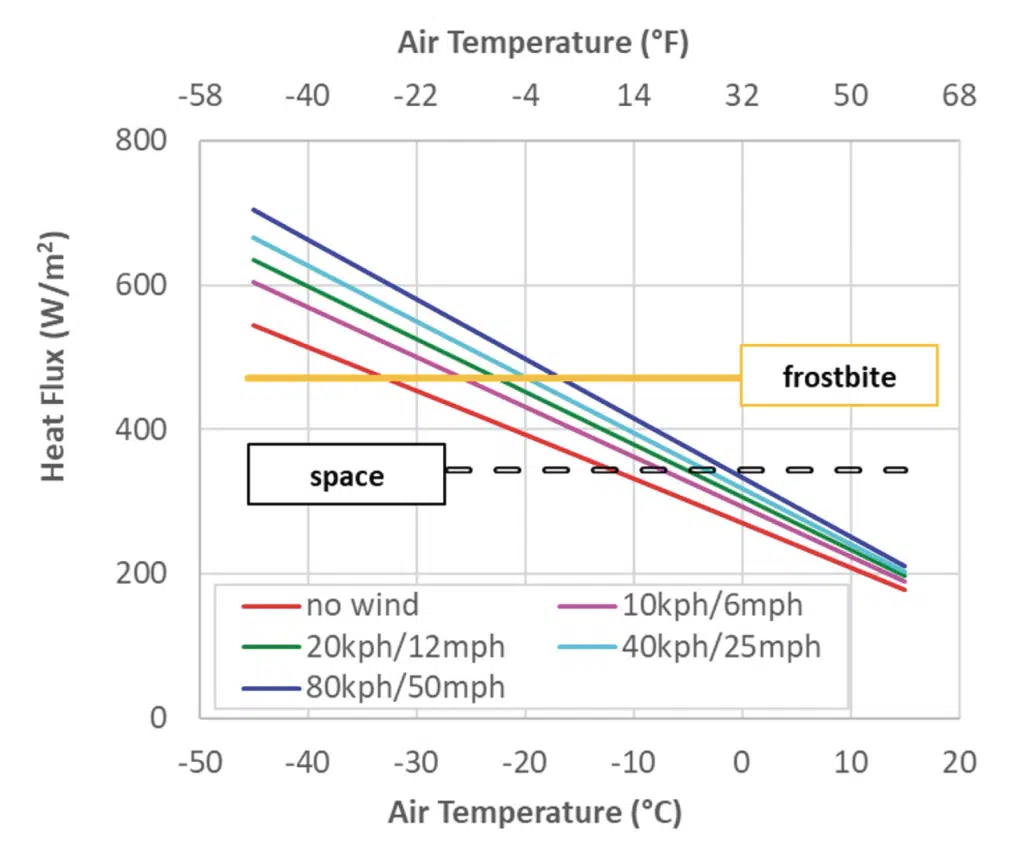
These equations were developed by making a number of assumptions and simplifications regarding geometry, material properties, and radiation effects (see Figure 2). Again, the approach for determining the wind chill index was to first determine the heat flux from human skin under conditions with no wind and then comparing that to the heat flux occurring when the wind is blowing. below are the estimated heat flux values corresponding to different ambient temperatures and wind speeds. The values shown in this figure are estimates – Reference [1] did not explicitly document all of the parameters used to determine equations {1}. The spreadsheet-based analysis used to generate Figure 1 was generally accurate to within 1-2°C.
Assumptions/Simplifications used in determining wind chill index
- The analysis used an internal thermal resistance (between internal body temperature and skin) of 0.091 Km2/W. This was based on human testing in which test subjects walked on a treadmill with cold air blowing on them while heat flux and body temperatures (external and internal) were monitored.
- Heat transfer is from the face, which is modeled as a cylinder with a diameter of 18cm, because the face is generally the most exposed surface.
- Internal body temperature is assumed to be 38°C.
- Heat loss conducts from the internal body to the skin and then leaves by convection to air, radiation to the sky, or radiation to the ground.
- ‘No wind’ case assumes walking at 1.34 m/s.
- ‘Wind’ conditions assume velocity is 2/3 value measured (~3 m above ground) plus the 1.34 m/s (the person is assumed to be walking into the wind).
- Skin radiates to both the ground and the sky, with temperatures that varied slightly with wind speed; radiant heat transfer was ~20% of the total.
- Assumes no effects of humidity or evaporation from skin.
- Heat transfer conditions are assumed to be steady-state.
As seems logical, colder temperatures and higher wind speeds increase the heat flux. At a heat flux (leaving the body) of ~470 W/m2, skin temperature is ~-5°C, which is the point at which frostbite can occur relatively quickly (approximately 20 minutes).
Enjoying this article?
Subscribe to Electronics Cooling for practical, engineer-focused insight on today’s thermal management challenges—plus immediate access to new digital magazine issues.
Subscribe here →
On a peripherally related topic, outer space may be thought of as an extreme case of cold temperatures given that it is near absolute zero. However, since outer space is a vacuum, there is no convection heat transfer and it turns out that it wouldn’t ‘feel’ all that cold [2]. Applying the same equations used to generate the wind chill index, but with no convection, skin emissivity of 0.985 [3] and a ‘sky’ temperature of 2.7K [4], the estimated skin temperature is ~7°C and the heat loss is ~340W/m2. As shown in Figure 1, this heat flux is approximately the same as a day with no wind and an air temperature of ~-14°C (~7°F). This is still relatively cold (although, after a long winter in the Midwest, some of us might consider it to be balmy), but is not sufficient to cause the instantaneous freeze that is occasionally shown in some science fiction movies. Three conclusions can be drawn from this observation:
- If you ever find yourself outside your spacecraft without a space suit, perhaps the only thing that you don’t need to worry about is temperature.
- During the next polar vortex, TV weather forecasters who really want to get their audience’s attention should report that tomorrow’s weather will “be 50% colder than space!” than “have a -40 degree wind chill.”
- Proponents of data centers in space may want to keep this in mind when suggesting that the cold temperature makes it a great place to dissipate heat.
It should be noted that the heat flux calculations shown in Figure 1 assume that there is no energy transfer due to evaporation from the skin. This was likewise done in the wind chill factor calculation. Clearly any moisture on the skin, such as the tongue, will boil and cause local freezing [5].
You may be asking yourself at this point what this has to do with electronics cooling? The simple answer is, not a whole lot. And that’s the point. If you work in the electronics cooling discipline for any length of time, it is almost a certainty that a system engineer, electrical engineer, director, or maybe even a mechanical engineer might suggest that you “put a bigger fan in the system and get a little wind chill to fix that thermal problem”. Hopefully, that is just their way of saying that they want to reduce thermal resistance. However, there are people who take the wind chill lesson learned from TV weather forecasters to believe that the faster air moves, the colder things get. The reality is that, no matter what the air velocity is, surfaces will not become any cooler that the ambient air temperature2.
In addition to the potential mistaken belief that a high enough airflow can somehow provide a refrigeration effect that cools surfaces below ambient temperature, engineers can also fall into the trap of believing that more airflow will inherently increase the heat flux. Under the best of conditions there is a law of diminishing return – in turbulent flow, the heat transfer coefficient generally scales with the square root of the flow speed. So, reducing the convective thermal resistance by half requires four times the flow rate – which can lead to a ~16x increase in pressure drop. This trend is shown in Figure 1, in which the increase in heat flux between 10 and 20 kph is approximately the same as the improvement that is seen between 40 and 80 kph. In fully developed laminar flow, the heat transfer coefficient does not change with flow speed.
Larger cooling fans generating higher speed flows will generally reduce overall thermal resistance. Even if the flow is primarily laminar, changes to developing flow effects and local turbulence generation will likely lead to local increases in convection coefficient. More importantly, higher mass flow rates will reduce the latent heating effects of coolant as it moves through a system; a higher flow rate for a given power dissipation means that the exit air temperature, and therefore average coolant temperature within a system, is lower. The key to understanding whether a higher flow rate (a bigger fan) will give you a better ‘wind chill factor’ is understanding the system. If the flow rate is already high enough that the dissipated power only increases the temperature of the cooling air by a couple degrees as it passes through the system, increasing the flow rate won’t help all that much. On the other hand, if a cooling fan actually is not providing sufficient airflow so that the exit air temperature is much higher than the inlet, a bigger fan can improve the thermal management. But no matter what kind of ‘wind chill’ the bigger fan produces, the air temperature will never actually be lower than ambient – regardless of what the TV weather forecaster may imply.
Acknowledgement: The author thanks his co-worker, Diego Mugurusa, for reviewing this article and finding an error in the initial version of Figure 1.
1 The author recalls once watching the local weather channel with his university roommates during a particularly cold and windy day in the 1980’s, while the earlier wind chill index equations were still in use. All viewers in the room were required to drink a beer any time that the instantaneous wind chill fell below -100°F (-73°C).
2 The exception to this is, of course, cases in which surfaces can radiate to an object that is cold enough that radiation effects exceed those of convection. Examples of this are the space chill factor described previously or a night in which the humidity is low enough that the effective sky temperature is extremely low and there is very little wind.
References
[1] Randal Osczevski and Maurice Bluestein, “The New Wind Chill Equivalent Temperature Chart”, Bulletin of American Metrological Society, 86: 1453-1458, 2005, https://journals.ametsoc.org/view/journals/bams/86/10/bams-86-10-1453.xml
[2] Paul Sutter, “You Will Not Freeze To Death In Space”, https://www.forbes.com/sites/paulmsutter/2019/04/05/you-will-not-freeze-to-death-in-space/
[3] “Table of Emissivity of Various Surfaces” http://www-eng.lbl.gov/~dw/projects/DW4229_LHC_detector_analysis/calculations/ emissivity2.pdf
[4] “How Cold is Space”, https://www.universetoday.com/77070/how-cold-is-space/
[5] NASA ‘Ask an Astrophysicist’, https://imagine.gsfc.nasa.gov/ask_astro/space_travel.html?http://www.nasm.si.edu