Editorial Note
The following transcript is adapted from a presentation delivered by Henkel at Thermal Live Fall 2025. It is shared here to provide readers with access to the technical discussion in written form. For the complete presentation experience, including slides and audience Q&A, the full session is available to watch on demand.
Introduction
In this session, we will explore an innovative silicone-free thermal gap pad line from Henkel that offers superior thermal conductivity, balanced mechanical properties, and excellent long-term stability.
The outline of the talk today is, first, we will go through optical networks. Then I’ll give you some information about thermal interface materials and what products Henkel is offering for the specific applications in this space. And then we will go to actual applications that we have used our thermal offerings in. And then at the end, I’ll give you a summary.
Optical Networks
Optical networks are the backbone of modern communications, and we can list three reasons for that. With optical networks, since we use photons to transmit data, we can get to higher speeds and higher bandwidths. This allows us to get to faster Internet speeds, which can be beneficial for applications in AI or streaming high-definition videos.
Optical networks are very reliable. They have low latency. This is due to the fact that they are less susceptible to interference and noise versus electrical setups, and data transmission is done with minimum delay. This can be beneficial for video conference gaming and financial transactions.
Optical networks are also scalable and very flexible architectures. You can accommodate increasing data rates without disrupting the current infrastructure.
With higher speed and higher power, there comes the need for more heat dissipation and more thermal management challenges. Thermal management architectures have evolved over time. We started with air cooling, then liquid cooling, and now the up-and-coming method is immersion cooling.
The interfaces for thermal interface materials are always the bottlenecks. Thermal interface materials should be designed to be compatible with the applications, and more specifically, compatible with the optical requirements we are getting from customers. Since immersion cooling is an up-and-coming thermal management solution, we want to make sure our offerings are also performing optimally under immersion cooling conditions.
Thermal Interface Materials and Products Henkel Is Offering for the Specific Applications in This Space
Thermal interface materials can be categorized based on various factors. Bond line thickness is one of them. For less than 0.1 mm bond line thickness, we are typically looking at greases and phase change materials. As we go thicker, thermal gap pads, fillers, potties, and gels can be considered.
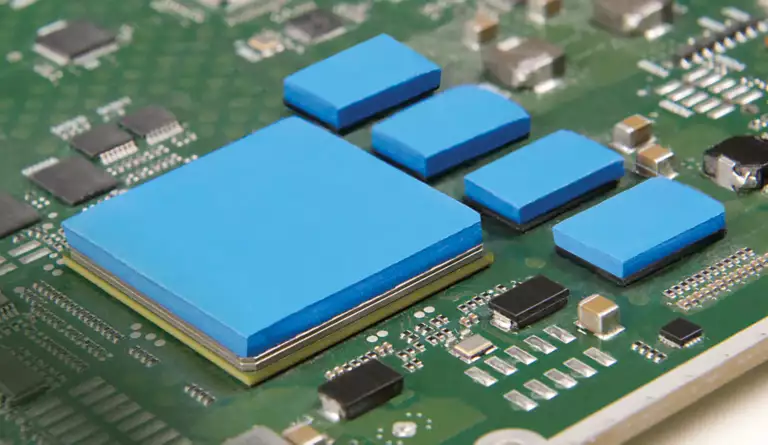
Form factor is another consideration. Some applications require dispensed liquids, while others require pick-and-place pads. With liquids, viscosity and dispensed amount can be controlled, and fewer parts are required. With pads, you get custom cut size and shape, easier handling, and in most cases, reworkability.
Thermal interface materials can be electrically insulating or electrically conducting. This depends on the filler type. Ceramic fillers provide electrical insulation, good voltage breakdown, and dielectric constants. Carbon or metallic fillers are very conductive, and electrical isolation is no longer present.
Polymer chemistry is also very important. Materials can be silicone or non-silicone. In optical network applications, most customers are looking for low bleed and low outgassing thermal interface materials, and some customers are only interested in silicone-free materials.
We use a patented technology to develop our silicone-free thermal gap pads. In this technology, we orient carbon or ceramic pillars through the thickness of the thermal gap pad, forming an effective heat pathway that enables high conductivities or low thermal impedances.
The formulations are silicone-free, and they have been tested for both bleed and outgassing, with very low numbers compared to competitors. These are elastomeric gap pads, offered in standard thicknesses from 0.5 mm to 3.2 mm. They are easy to handle and can be used in assembly lines.
These formulations also consider sustainability. The pads are reworkable, there is no cure chemistry, and end-of-life disassembly is possible.
There are currently four silicone-free thermal gap pads that Henkel is working on, and they will soon be commercialized. The thermal conductivity ranges from 12 W/m·K to 30 W/m·K.
Enjoying this article?
Subscribe to Electronics Cooling for practical, engineer-focused insight on today’s thermal management challenges—plus immediate access to new digital magazine issues.
Subscribe here →
Mechanical and Thermal Performance
Representative measurements are shown for 12 W/m·K and 30 W/m·K materials currently in development.
For 0.5–1.5 mm thickness, thermal impedance improves or remains unchanged with increasing pressure. At ≥ 2 mm, alignment breakdown can occur and thermal impedance increases, though values remain comparable to lower-pressure conditions.
Compression testing shows that after reaching peak stress, the material relaxes quickly to a low relaxed stress value that is maintained over time, ensuring good surface contact and effective heat transfer.
Actual Applications That We Have Used Our Thermal Offerings In
Oil bleed testing at 125°C for 1,000 hours shows that both 12 W/m·K and 30 W/m·K materials perform better than other tested gap pads.
NASA outgassing testing shows total mass loss around 0.7 wt%, with CVCM between 0.08–0.09 wt%.
Reliability testing includes temperature cycling from −40°C to 125°C for up to 1,000 cycles, under both constant pressure and constant strain. No major red flags were observed.
Primary applications include optical transceivers and copackaged optics. Additional applications include AI accelerators, immersion cooling systems, vehicle control units, lidar sensors, camera modules, ADAS, and aerospace and defense systems.
Summary
The silicone-free thermal gap pads discussed use a patented oriented-filler technology to achieve low thermal impedance, strong mechanical compliance, low bleed, and low outgassing. They are elastomeric, reworkable, and suitable for next-generation optical, automotive, and aerospace systems.
Watch the Full Presentation On-Demand
This presentation was originally delivered as part of Thermal Live Fall 2025.
To view the full session, including presentation slides, figures, and audience Q&A, visit thermal.live to access the on-demand recording.