As direct-to-chip liquid cooling moves from pilot projects to larger AI and high-performance computing deployments, maintaining coolant health is becoming an increasingly important part of the thermal reliability equation. Beyond selecting a fluid with the right thermal properties, engineering teams must consider coolant chemistry, system commissioning, sampling and testing, and how fluid condition is managed throughout the life of the cooling system.
Recently, Electronics Cooling sat down with Keegan Yaroch, Dow Technical Scientist, to discuss the practical engineering considerations behind coolant reliability in high-density liquid-cooled environments and how a more structured approach to fluid management can help support long-term system performance. The full Q&A follows.
Electronics Cooling Magazine (ECM): Dow recently launched the Dow Coolant Care Network. How does this reflect the changing role of coolant management in direct-to-chip data center cooling?
Keegan Yaroch (KY): While liquid cooling in data centers is still relatively recent, its adoption is driving a significant shift in thermal management. Direct-to-chip cooling loops operate under stringent performance and reliability requirements, leaving little room for deviations in coolant quality or system operation. Managing coolant health is therefore essential to reliable operation.
With that in mind, data center operators now require a structured approach that enables continuous monitoring of coolant health, clear interpretation of trends, and proactive intervention before issues impact performance or uptime.
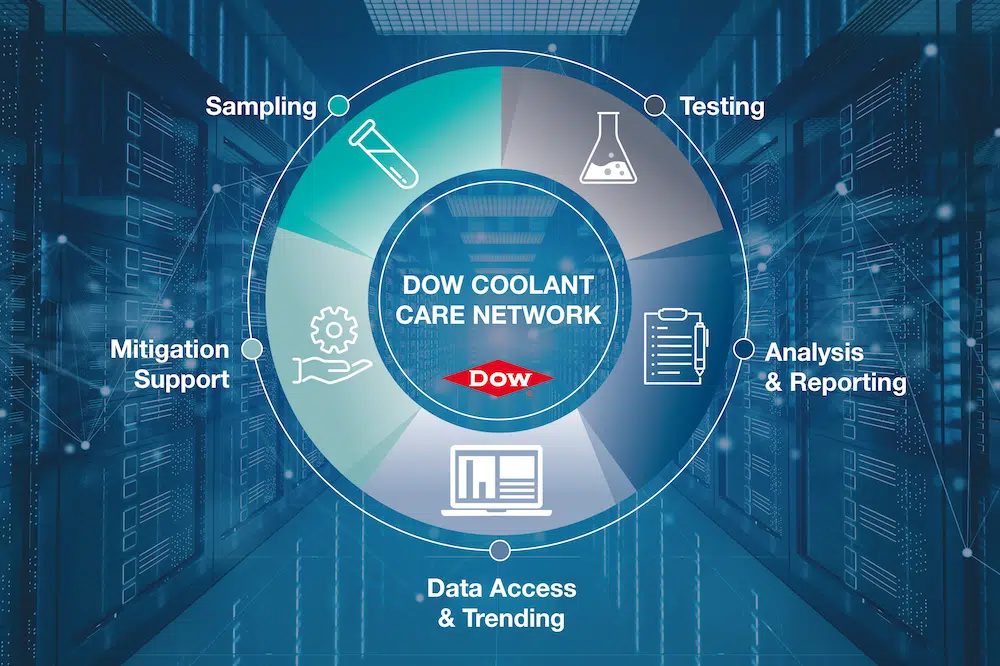
In response to this shift, the Dow Coolant Care Network brings together the critical elements needed to support long fluid service life: laboratory testing, data analysis, expert interpretation and mitigation support across both primary and secondary cooling loops.
Rather than managing multiple vendors independently, data center operators can work within a network of Dow-approved laboratories and service providers, supported by Dow’s technical knowledge and recommendations for fluid management. This integrated approach simplifies the management of DOWFROST™ LC and DOWFROST™ HD Heat Transfer Fluids, helping to reduce operational risk, improve consistency, and support overall cooling system reliability and uptime.
ECM: As liquid cooling becomes more common in AI and HPC data centers, why should coolant health be part of the thermal reliability strategy?
KY: In liquid-cooled systems, especially direct-to-chip architectures, thermal reliability depends not only on effective heat removal, but also on maintaining fluid stability and integrity over time. In the high-demand environments typical of AI and HPC data centers, even small changes in coolant chemistry or cleanliness can directly impact system performance, equipment protection, and uptime.
ECM: What coolant-related baselines should engineering teams establish during design or commissioning?
KY: Baselines should be established for both the system and the fluid. On the system side, Dow recommends confirming wetted-material compatibility, validating mechanical integrity, and implementing a robust commissioning plan prior to startup. Thorough cleaning and flushing are critical to remove fabrication debris, residues and other contaminants that can compromise coolant stability, restrict flow, or damage components. Long-term fluid health relies heavily on proper commissioning from the start.
Following installation of the coolant as well as adequate circulation, a representative sample should be analyzed to confirm that the coolant meets applicable fluid specifications and OEM-recommended operating ranges. Key parameters include concentration, appearance, pH, reserve alkalinity, inhibitor concentrations, metals and other contaminants that may be introduced during commissioning. These results establish a baseline for the newly commissioned system, enabling changes in fluid chemistry, cleanliness or system conditions to be identified and addressed early.
ECM: What should engineers consider when designing sampling access into a liquid cooling system?
KY: Sampling access should be designed to provide a representative sample of the circulating coolant safely and consistently. Sampling points should be located in well-circulated sections of the loop, away from dead legs, stagnant zones, or other low-flow areas that could produce misleading results. Sampling points should also be readily accessible and designed to minimize contamination during collection. Sampling from the same locations after system fill, following maintenance, and during routine operation enables meaningful trend analysis and early identification of changes in coolant health.
ECM: When a coolant sample is tested through a program like the Dow Coolant Care Network, which results are most useful for understanding system health?
KY: The most useful results are those that indicate both the current performance of the fluid and how it interacts with the system over time. Key parameters include fluid concentration and composition, appearance and clarity, pH, and inhibitor health (such as reserve alkalinity), which together show whether the coolant is performing as intended.
Equally important are indicators of system interaction, such as dissolved metals, contamination levels, and the presence of particulates. These metrics can provide early signals of corrosion, material degradation, or system cleanliness issues.
When evaluated together, these results enable operators to move beyond a simple pass/fail assessment and instead understand trends in fluid condition, supporting earlier intervention and more informed decisions to maintain overall system reliability and uptime.
Through the Dow Coolant Care Network, these results are further interpreted by Dow technical specialists, who translate the data into clear, actionable recommendations to help operators identify root causes and define the most appropriate corrective actions.
ECM: Beyond thermal conductivity or specific heat, what coolant characteristics should engineers consider when evaluating long-term performance?
KY: While thermal properties such as conductivity and specific heat are important, long-term coolant performance depends on a broader set of characteristics that directly impact system reliability. These include corrosion protection, thermal and chemical stability, and compatibility with metals, elastomers, and polymers used throughout the system. Engineers should also consider fluid purity, as contaminants can lead to fouling, scaling, or deposit formation over time. In addition, the fluid should demonstrate strong resistance to oxidation and degradation under continuous thermal stress. Additional factors such as biostability, and leak detectability can also play a critical role in maintaining consistent operation and simplifying maintenance.
ECM: If testing identifies contamination, degradation, or corrosion risk, what does a practical response process look like?
KY: A practical response process starts with structured interpretation, not guesswork. Dow Coolant Care Network model is built around a coordinated approach that includes sampling, testing through approved laboratories, data upload, and expert review, culminating in a report that provides an overall system status along with clear, actionable recommendations.
If this coolant is found to be outside of recommended operating limits, Dow will provide guidance on additives to introduce into the system, as well as dosage rates, to bring the fluid back to within specifications.
If the issue is linked to contamination or commissioning contaminants, the guidance typically focuses on targeted mitigation actions supported by approved service providers. In cases where fluid health has declined significantly, Dow also provides guidance on adjusting glycol concentration, filtration, increasing monitoring frequency as well as other tailored recommendations to extend the service life of the coolant.
Ultimately, this structured approach enables operators to move quickly from diagnosis to resolution, reducing uncertainty, minimizing downtime risk, and restoring system conditions to support reliable, long-term system performance.
ECM: Looking ahead, how do you expect coolant care requirements to evolve as rack densities continue to rise?
KY: As rack densities continue to rise, coolant care will become more proactive, data-driven, and tightly integrated with system performance. Higher heat flux and more complex loop designs increase sensitivity to fluid quality, making consistent monitoring, contamination control, and lifecycle management critical to maintaining reliability and efficiency. We expect a shift from periodic maintenance toward continuous condition monitoring, supported by deeper lab-based analysis to detect early signs of degradation, contamination, or material incompatibility. This is where networks like the Dow Coolant Care Network will play an increasingly important role, combining real-time insights with advanced analytical capabilities to ensure fluids are not only specified correctly at startup, but actively managed to deliver long-term performance at scale.
ECM: What is the main takeaway you would want thermal engineers and data center infrastructure teams to remember about coolant care as liquid cooling becomes a larger part of the data center thermal strategy?
KY: The key takeaway is that coolants are more than a heat-transfer medium, they are critical to overall system reliability. Coolant care should therefore be integrated throughout the system lifecycle rather than treated as a periodic maintenance task. Long-term performance depends on attention to detail at every stage, from system design and coolant selection through commissioning, routine monitoring, and ongoing operation.
Ultimately, reliable liquid cooling is choosing the right fluid and it’s about maintaining fluid health throughout the system lifecycle. A structured, data-driven approach, combining fluid analysis, expert interpretation, and proactive management, helps protect equipment, extend fluid service life, and support stable, predictable thermal performance as data center demands continue to grow.
Learn More About the Dow Coolant Care Network
The Dow Coolant Care Network brings fluid supply, testing, data analysis, specialist interpretation, and mitigation support together in a coordinated approach designed to help data center operators manage coolant health and support reliable cooling system performance.
Learn more about the Dow Coolant Care Network, including its approved service and analysis providers, on Dow’s website.