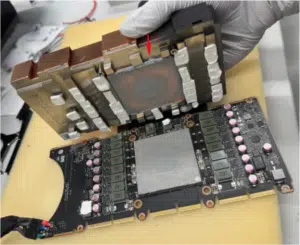
Steady state operating temperature is a critical design parameter for ensuring the reliable operation of modern electronics systems. However, in practice it is but one of many factors that impact overall system health and performance. Modern challenges, like the large transient power draw associated with artificial intelligence (AI) workloads create the potential for more … [Read more...]
Statistics Corner: A Failure to Fail

Component reliability testing can lead to an inherent disagreement in what different people hope to see from the results. Designers who want to use the components hope that no components fail during qualification testing to verify that they meet the reliability requirement. In contrast, analysts who characterize the reliability of the components need a sufficient number of … [Read more...]
Engineering Leak-Free Performance for Mission-Critical Electronics

Chips are getting hotter, and liquid cooling is moving from niche to necessary. That transition changes what “good” looks like for fluid connections. Quick disconnect couplings have long lived in industrial settings, where design tolerances, qualification habits, and manufacturing controls matched those use cases. Data center liquid cooling—along with aerospace/defense and … [Read more...]
In-Package, Direct-on-chip Liquid Cooling with Lid-Compatible Manifold for Efficient AI Chip Thermal Management

Introduction The advancement of artificial intelligence (AI) has led to an accelerating development of high-performance AI chips, which are increasingly characterized by ultra-large die areas, extreme interconnect density, and high-power consumptions. Heat dissipation is a bottleneck for the next-generation high-power graphics processing unit (GPU) and necessitates advanced … [Read more...]
Thermal Design for Externally Worn Wearable Electronics

Introduction Thermal management plays a critical role in the performance, reliability, and longevity of wearable devices. Reliability must be considered even when components remain below their absolute maximum operating temperatures. This is due to increased diffusion rates, material fatigue, and electromigration effects which degrade electronics over time. Additional failure … [Read more...]
- 1
- 2
- 3
- …
- 128
- Next Page »