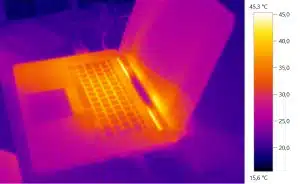
EDITOR'S NOTE: This article is based on a presentation delivered at Thermal Live Fall 2025 by Mark MacDonald, Thermal Technologist at Ventiva, where he outlined how electrohydrodynamic (EHD) air movers — branded as the Ionic Cooling Engine (ICE) — are redefining thermal system architecture. For decades, electronics cooling has relied on mechanical blowers. Bearings spin, … [Read more...]
Highlights From the 19th ASME InterPACK Conference

The 2025 International Technical Conference and Exhibition on Packaging and Integration of Electronic and Photonic Microsystems (InterPACK 2025) was held from October 28–30, 2025, at the Hotel Fera Anaheim, a DoubleTree by Hilton, in Anaheim, California. Hosted by the ASME Electronic and Photonic Packaging Division (EPPD), the conference served as a premier forum for advancing … [Read more...]
Introducing THERM-A-GAP GEL 120: Parker Chomerics’ Highest Performing Thermal Gap Filler Gel
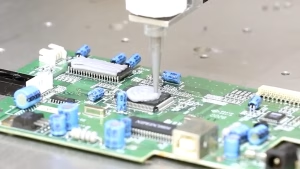
As electronic applications become more sophisticated and higher performing, the need for thermal performance that can keep pace is increasing. Parker is excited to continue pushing the bar and helping their customers accelerate innovation with THERM-A-GAP GEL 120 which offers a game-changing thermal conductivity of 12.0 W/m-K. THERM-A-GAP GEL 120 is a one-component, … [Read more...]
Rethinking Thermal Design Priorities in Electronics Packaging
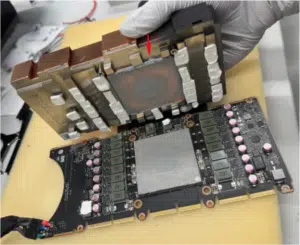
Steady state operating temperature is a critical design parameter for ensuring the reliable operation of modern electronics systems. However, in practice it is but one of many factors that impact overall system health and performance. Modern challenges, like the large transient power draw associated with artificial intelligence (AI) workloads create the potential for more … [Read more...]
Thermal Design for Externally Worn Wearable Electronics

Introduction Thermal management plays a critical role in the performance, reliability, and longevity of wearable devices. Reliability must be considered even when components remain below their absolute maximum operating temperatures. This is due to increased diffusion rates, material fatigue, and electromigration effects which degrade electronics over time. Additional failure … [Read more...]
- 1
- 2
- 3
- …
- 55
- Next Page »