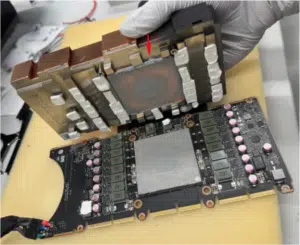
Steady state operating temperature is a critical design parameter for ensuring the reliable operation of modern electronics systems. However, in practice it is but one of many factors that impact overall system health and performance. Modern challenges, like the large transient power draw associated with artificial intelligence (AI) workloads create the potential for more … [Read more...]
Statistics Corner: A Failure to Fail

Component reliability testing can lead to an inherent disagreement in what different people hope to see from the results. Designers who want to use the components hope that no components fail during qualification testing to verify that they meet the reliability requirement. In contrast, analysts who characterize the reliability of the components need a sufficient number of … [Read more...]
Engineering Leak-Free Performance for Mission-Critical Electronics
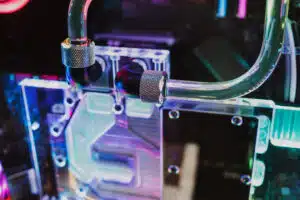
Chips are getting hotter, and liquid cooling is moving from niche to necessary. That transition changes what “good” looks like for fluid connections. Quick disconnect couplings have long lived in industrial settings, where design tolerances, qualification habits, and manufacturing controls matched those use cases. Data center liquid cooling—along with aerospace/defense and … [Read more...]
THERMINIC 2025: A Landmark Workshop on Thermal Management and Electronics Reliability

The 31st international workshop on THERMal INvestigations of ICs and systems (THERMINIC) took place on 24–26 September 2025 in Naples, Italy, hosted at the Centro Congressi (Conference Center) of University Federico II. This year’s workshop not only broke attendance records but also showcased the seamless integration of cutting-edge research and industrial innovation in the … [Read more...]
Direct-Die Liquid Cooling: A Scalable Approach for Power Module Thermal Integration
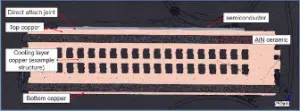
Abstract This paper presents a novel thermal management approach for power semiconductor modules by integrating active liquid cooling directly into the substrate. Utilizing Direct Bond Copper (DBC) structures embedded within liquid cold plates, the method minimizes thermal interfaces, improves power density, and ensures better reliability. It contrasts traditional … [Read more...]