
Abstract Extreme conditions in interplanetary environments, like lunar night at -173°C and Martian dust storms, require new thermal control systems that go beyond traditional electronics cooling approaches. Martian dust consists primarily of iron-oxide and silicate particles with diameters ranging from 1 to 3 μm. These particles are electrostatically adhesive, capable of … [Read more...]
Condenser Array Design for High-Density Data Centers

Introduction In recent years, the power density of server racks has surged past 100 kW/rack [1] to support compute-intensive workloads such as artificial intelligence and data analytics. Cooling systems play an increasingly important role in enabling such densification improvements and in improving overall data center energy consumption, equipment reliability, and total cost … [Read more...]
Rethinking Thermal Design Priorities in Electronics Packaging
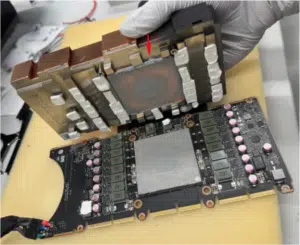
Steady state operating temperature is a critical design parameter for ensuring the reliable operation of modern electronics systems. However, in practice it is but one of many factors that impact overall system health and performance. Modern challenges, like the large transient power draw associated with artificial intelligence (AI) workloads create the potential for more … [Read more...]
Statistics Corner: A Failure to Fail

Component reliability testing can lead to an inherent disagreement in what different people hope to see from the results. Designers who want to use the components hope that no components fail during qualification testing to verify that they meet the reliability requirement. In contrast, analysts who characterize the reliability of the components need a sufficient number of … [Read more...]
Engineering Leak-Free Performance for Mission-Critical Electronics

Chips are getting hotter, and liquid cooling is moving from niche to necessary. That transition changes what “good” looks like for fluid connections. Quick disconnect couplings have long lived in industrial settings, where design tolerances, qualification habits, and manufacturing controls matched those use cases. Data center liquid cooling—along with aerospace/defense and … [Read more...]
- « Previous Page
- 1
- …
- 3
- 4
- 5
- 6
- 7
- …
- 40
- Next Page »