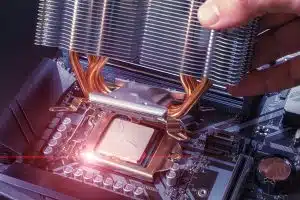
Thermal management has become one of the defining challenges in modern electronics design. Across data centers, AI and machine learning hardware, power electronics, and compact consumer devices, heat generation continues to rise as performance expectations increase. Higher power densities, faster processing speeds, and smaller form factors are placing sustained pressure on … [Read more...]
High-Performance Copper Tungsten Cold Plates for Direct-to-Chip Single-Phase Liquid Cooling
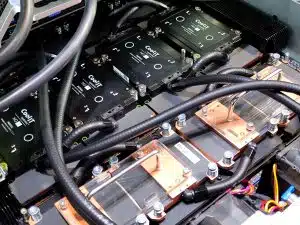
In April 2025, Google announced its 1 MW 42U rack [1], marking a turning point in data center thermal management where traditional air cooling can no longer support the extreme power densities of modern hardware. As chip thermal design power (TDP) continues to grow, data centers must replace air-cooled heat sinks with liquid-cooled cold plates [2]. Cold plates transfer heat … [Read more...]
Silicone-Free Thermal Gap Pads for Optical and Datacom Systems

Editorial Note The following transcript is adapted from a presentation delivered by Henkel at Thermal Live Fall 2025. It is shared here to provide readers with access to the technical discussion in written form. For the complete presentation experience, including slides and audience Q&A, the full session is available to watch on demand. Introduction In this … [Read more...]
Introducing THERM-A-GAP GEL 120: Parker Chomerics’ Highest Performing Thermal Gap Filler Gel
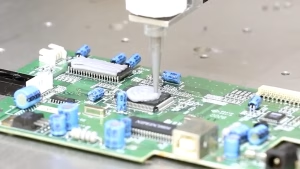
As electronic applications become more sophisticated and higher performing, the need for thermal performance that can keep pace is increasing. Parker is excited to continue pushing the bar and helping their customers accelerate innovation with THERM-A-GAP GEL 120 which offers a game-changing thermal conductivity of 12.0 W/m-K. THERM-A-GAP GEL 120 is a one-component, … [Read more...]
Spacecraft Thermal Control in Extreme Environments: Surviving Lunar Night and Martian Dust

Abstract Extreme conditions in interplanetary environments, like lunar night at -173°C and Martian dust storms, require new thermal control systems that go beyond traditional electronics cooling approaches. Martian dust consists primarily of iron-oxide and silicate particles with diameters ranging from 1 to 3 μm. These particles are electrostatically adhesive, capable of … [Read more...]
- « Previous Page
- 1
- 2
- 3
- 4
- 5
- …
- 48
- Next Page »